This article was originally published in the September 1987 issue of Working Mother magazine and was the seed for my January 2001 article in Taekwondo Times magazine titled "No Point: The Case Against Competition in the Martial Arts." Please enjoy!
The Case Against Competition
By Alfie Kohn
When it comes to competition, we Americans typically recognize only two legitimate positions: enthusiastic support and qualified support.
The first view holds that the more we immerse our children (and ourselves) in rivalry, the better. Competition builds character and produces excellence. The second stance admits that our society has gotten carried away with the need to be Number One, that we push our kids too hard and too fast to become winners -- but insists that competition can be healthy and fun if we keep it in perspective.
I used to be in the second camp. But after five years of investigating the topic, looking at research from psychology, sociology, education and other fields. I'm now convinced that neither position is correct. Competition is bad news all right, but it's not just that we overdo it or misapply it. The trouble lies with competition itself. The best amount of competition for our children is none at all, and the very phrase "healthy competition" is actually a contradiction in terms.
That may sound extreme if not downright un-American. But some things aren't just bad because they're done to excess; some things are inherently destructive. Competition, which simply means that one person can succeed only if others fail, is one of those things. It's always unnecessary and inappropriate at school, at play and at home.
Think for a moment about the goals you have for your children. Chances are you want them to develop healthy self-esteem, to accept themselves as basically good people. You want them to become successful, to achieve the excellence of which they're capable. You want them to have loving and supportive relationships. And you want them to enjoy themselves.
These are fine goals. But competition not only isn't necessary for reaching them -- it actually undermines them.
Competition is to self-esteem as sugar is to teeth. Most people lose in most competitive encounters, and it's obvious why that causes self-doubt. But even winning doesn't build character; it just lets a child gloat temporarily. Studies have shown that feelings of self-worth become dependent on external sources of evaluation as a result of competition: Your value is defined by what you've done. Worse -- you're a good person in proportion to the number of people you've beaten.
In a competitive culture, a child is told that it isn't enough to be good -- he must triumph over others. Success comes to be defined as victory, even though these are really two very different things. Even when the child manages to win, the whole affair, psychologically speaking, becomes a vicious circle: The more he competes, the more he needs to compete to feel good about himself.
When I made this point on the Phil Donahue Show, my objections were waved aside by the parents of a seven-year-old tennis champion named Kyle, who appeared on the program with me. Kyle had been used to winning ever since a tennis racket was put in his hands at the age of two. But at the very end of the show, someone in the audience asked him how he felt when he lost. Kyle lowered his head and in a small voice replied, "Ashamed."
This is not to say that children shouldn't learn discipline and tenacity, that they shouldn't be encouraged to succeed or even have a nodding acquaintance with failure. But none of these requires winning and losing -- that is, having to beat other children and worry about being beaten. When classrooms and playing fields are based on cooperation rather than competition, children feel better about themselves. They work with others instead of against them, and their self-esteem doesn't depend on winning a spelling bee or a Little League game.
Children succeed in spite of competition, not because of it. Most of us were raised to believe that we do our best work when we're in a race -- that without competition we would all become fat, lazy and mediocre. It's a belief that our society takes on faith. It's also false.
There is good evidence that productivity in the workplace suffers as a result of competition. The research is even more compelling in classroom settings. David Johnson, a professor of social psychology at the University of Minnesota, and his colleagues reviewed all the studies they could find on the subject from 1924 to 1980. Sixty-five of the studies found that children learn better when they work cooperatively as opposed to competitively, eight found the reverse, and 36 found no significant difference. The more complex the learning task, the worse children in a competitive environment fared.
Brandeis University psychologist Teresa Amabile was more interested in creativity. She asked 22 girls, ages seven to 11, to make "silly collages." Some competed for prizes and some didn't. Seven artists then independently rated the girls' work. It turned out that the children who were trying to win produced collages that were much less creative -- less spontaneous, complex and varied -- than the others.
One after another, researchers across the country have concluded that children do not learn better when education is transformed into a competitive struggle. Why? First, competition often makes kids anxious and that interferes with concentration. Second, competition doesn't permit them to share their talents and resources as cooperation does, so they can't learn from one another. Finally, trying to be Number One distracts them from what they're supposed to be learning. It may seem paradoxical, but when a student concentrates on the reward (an A or a gold star or a trophy), she becomes less interested in what she's doing. The result: Performance declines.
Just because forcing children to try to outdo one another is counterproductive doesn't mean they can't keep track of how they're doing. There's no problem with comparing their achievements to an objective standard (how fast they ran, how many questions they got right) or to how they did yesterday or last year. But any mother who values intellectual development for her child should realize that turning learning into a race simply doesn't work.
Competition is a recipe for hostility. By definition, not everyone can win a contest. If one child wins, another cannot. This means that each child inevitably comes to regard others as obstacles to his or her own success. Forget fractions or home runs; this is the real lesson our children learn in a competitive environment.
Competition leads children to envy winners, to dismiss losers (there's no nastier epithet in our language than "Loser!") and to be suspicious of just about everyone. Competition makes it difficult to regard others as potential friends or collaborators; even if you're not my rival today, you could be tomorrow.
This is not to say that competitors will always detest each other. But trying to outdo someone is not conducive to trust -- indeed, it would be irrational to trust someone who gains from your failure. At best, competition leads one to look at others through narrowed eyes; at worst, it invites outright aggression. Existing relationships are strained to the breaking point, while new friendships are often nipped in the bud.
Again, the research helps to explain the destructive effect of win/lose arrangements. When children compete, they are less able to take the perspective of others -- that is, to see the world from someone else's point of view. One study demonstrated conclusively that competitive children were less empathetic than others; another study showed that competitive children were less generous.
Cooperation, on the other hand, is marvelously successful at helping children to communicate effectively, to trust in others and to accept those who are different from themselves. Competition interferes with these goals and often results in outright antisocial behavior. The choice is ours: We can blame the individual children who cheat, turn violent or withdraw, or we can face the fact that competition itself is responsible for such ugliness.
Studies also show, incidentally, that competition among groups isn't any better than competition among individuals. Kids don't have to work against a common enemy in order to know the joys of camaraderie or to experience success. Real cooperation doesn't require triumphing over another group.
Having fun doesn't mean turning playing fields into battlefields. It's remarkable, when you top to think about it, that the way we teach our kids to have a good time is to play highly structured games in which one individual or team must defeat another.
Consider one of the first games our children learn to play: musical chairs. Take away one chair and one child in each round until one smug winner is seated and everyone else has been excluded from play. You know that sour birthday party scene; the needle is lifted from the record and someone else is transformed into a loser, forced to sit out the rest of the game with the other unhappy kids on the side. That's how children learn to have fun in America.
Terry Orlick, a Canadian expert on games, suggests changing the goal of musical chairs so children are asked to fit on a diminishing number of seats. At the end, seven or eight giggling, happy kids are trying to squish on a single chair. Everyone has fun and there are no winners or losers.
What's true of musical chairs is true of all recreation; with a little ingenuity, we can devise games in which the obstacle is something intrinsic to the task itself rather than another person or team.
In fact, not one of the benefits attributed to sports or other competitive games actually requires competition. Children can get plenty of exercise without struggling against each other. Teamwork? Cooperative games allow everyone to work together, without creating enemies. Improving skills and setting challenges? Again, an objective standard or one's own earlier performance will do.
When Orlick taught a group of children noncompetitive games, two thirds of the boys and all of the girls preferred them to games that require opponents. If our culture's idea of a good time is competition, it may just be because we haven't tried the alternative.
How can parents raise a noncompetitive child in a competitive world? Competition is actually destructive to children's self-esteem. It interferes with learning, sabotages relationships and isn't necessary for a good time. But how do you raise a child in a culture that hasn't yet caught on to this?
There are no easy answers here. But there is one clearly unsatisfactory answer: Make your son or daughter competitive in order to fit into the "real world." That isn't desirable for the child -- for all the reasons given here -- and it perpetuates the poison of competition in another generation.
Children can be taught about competition, prepared for the destructive forces they'll encounter, without being groomed to take part in it uncritically. They can be exposed to the case against competition just as they are taught the harms of drug abuse or reckless driving.
You will have to decide how much compromise is appropriate so your child isn't left out or ridiculed in a competitive society. But at least you can make your decision based on knowledge about competition's destructiveness. You can work with other parents and with your child's teachers and coaches to help change the structures that set children against one another. Of you may want to look into cooperative schools and summer camps, which are beginning to catch on around the country.
As for reducing rivalry and competitive attitudes in the home:
* Avoid comparing a child's performance to that of a sibling, a classmate, or yourself as a child.
* Don't use contests ("Who can dry the dishes fastest?") around the house. Watch your use of language ("Who's the best little girl in the whole wide world?") that reinforces competitive attitudes.
* Never make your love or acceptance conditional on a child's performance. Some parents give subtle messages; they may say to their child, "As long as you did your best..." but Bobby knows that Mommy really likes him better when he wins. Nothing is more psychologically destructive than making approval dependent on victory.
* Be aware of your power as a model. If you need to beat others, your child will learn that from you regardless of what you say. The lesson will be even stronger if you use your child to provide you with vicarious victories.
Raising healthy, happy, productive children goes hand in hand with creating a better society. The first step to achieving both is recognizing that our belief in the value of competition is built on myths. There are better ways for our children -- and for us -- to work and play and live.
Wednesday, February 04, 2009


Tuesday, February 03, 2009
Prep Time
Hi!
I'm often asked how much time one should spend preparing for a Toastmasters speech. My answer: It depends. Of course, it depends on what you want to get out of it. I don't think you always need to spend weeks and weeks preparing every little detail, nor do I think every speech should be a seat-of-the-pants affair. A good speaker can give a good seat-of-the-pants speech and really nail it when taking a lot of time to prepare. The key is to know when to do which.
I don't usually spend more than a few hours over a couple of days preparing for a speech. My justification is this: When giving a presentation for work, I rarely am afforded more than a few days advance notice and even then I have other things to do, so I can't spend all day preparing. In that case, why should Toastmasters be any different? At least if I use the same approach for my Toastmasters speeches, I'm getting practice for when I'm forced to use that approach for work. Toastmasters should be, above all else, preparation for when you have to do it for real. It's a means to an end, not an end itself. For real, in my case, is at work.
Of course, sometimes I like to go all out and see what I can do. I did this for my What Is Hip? speech last June. That was a LOT of work, but also a lot of fun. I wanted to see what I could do if I really put time and effort into preparing. I certainly won't do that every time, but I have found that lately I feel the need to prepare more. Not just because I want to do my absolute best, but because the more advanced Toastmasters projects call for it.
If you're a novice, though, you should plan on putting some time into preparation. If all your feedback is related to things you, of course, would have done differently if you'd spent more time preparing, then you're not going to learn much. Do your best! Toastmasters is a learning environment and it's only effective if you give it your all and still see room for improvement. With experience, you'll learn how to maximize the ROI of your preparation time by focusing on the aspects of your presentations that don't go well if you wing it. For example, some people need to write out every word, but don't need to practice much after that. Others may need to practice specific gestures or body movements they think will really help get their point across. Once you find out what your "problem areas" are, your prep time will be more efficient.
Thanks,
Matt
I'm often asked how much time one should spend preparing for a Toastmasters speech. My answer: It depends. Of course, it depends on what you want to get out of it. I don't think you always need to spend weeks and weeks preparing every little detail, nor do I think every speech should be a seat-of-the-pants affair. A good speaker can give a good seat-of-the-pants speech and really nail it when taking a lot of time to prepare. The key is to know when to do which.
I don't usually spend more than a few hours over a couple of days preparing for a speech. My justification is this: When giving a presentation for work, I rarely am afforded more than a few days advance notice and even then I have other things to do, so I can't spend all day preparing. In that case, why should Toastmasters be any different? At least if I use the same approach for my Toastmasters speeches, I'm getting practice for when I'm forced to use that approach for work. Toastmasters should be, above all else, preparation for when you have to do it for real. It's a means to an end, not an end itself. For real, in my case, is at work.
Of course, sometimes I like to go all out and see what I can do. I did this for my What Is Hip? speech last June. That was a LOT of work, but also a lot of fun. I wanted to see what I could do if I really put time and effort into preparing. I certainly won't do that every time, but I have found that lately I feel the need to prepare more. Not just because I want to do my absolute best, but because the more advanced Toastmasters projects call for it.
If you're a novice, though, you should plan on putting some time into preparation. If all your feedback is related to things you, of course, would have done differently if you'd spent more time preparing, then you're not going to learn much. Do your best! Toastmasters is a learning environment and it's only effective if you give it your all and still see room for improvement. With experience, you'll learn how to maximize the ROI of your preparation time by focusing on the aspects of your presentations that don't go well if you wing it. For example, some people need to write out every word, but don't need to practice much after that. Others may need to practice specific gestures or body movements they think will really help get their point across. Once you find out what your "problem areas" are, your prep time will be more efficient.
Thanks,
Matt
Monday, February 02, 2009
Super Bowl & Sports Memories
That's two years in a row that my team's star wide receiver scored a TD late to get the lead, only to see it slip away later, then watch a desperate comeback fail. It sucked. Seeing the Patriots lose last year was a shock. Seeing the Cardinals lose was a bummer. I don't buy into the "well they had a great year and should be proud they made it that far" talk. By the time a team gets to the Super Bowl, all they want to do is win. There's no way anyone in the Arizona locker room was talking about how much they proved by getting that far...they wanted to go all the way. And they almost did...
This got me to thinking...how many sporting events have I truly enjoyed? Not many. The fact is that when I care who wins, even if the team I want to win does, I don't particularly enjoy the game. I really enjoyed the Fiesta Bowl because I really didn't care who won. The same could be said of the uber-exciting 2003 Insight Bowl I attend with my brother. This past year's Insight Bowl was a blow-out of Minnesota by Kansas, so it wasn't very exciting. That's...about...it. I wouldn't even say that I particularly *enjoyed* the no-hitter I saw in 1999. This was, of course, an exciting game, but toward the end every pitch was excruciating because we were expecting a seeing-eye grounder or a broken-bat single.
I can't say that I ever truly enjoyed a Red Sox game, with the possible exception of this gem by Pedro Martinez. Strangely enough, this game was just a few weeks before I saw the no-hitter, so it was still fresh in my mind. However, since I always want the Red Sox to win, it's never truly enjoyable. Even when they do, like in 2004 and 2007, it's never enough to make up for the disappointment of 1986, 1999, 2003, 2008, and every other year that they weren't even close. I don't know what it is. I really would prefer not to care about sports. There are so many other things that are infinitely more worthy of my caring, but there are always times when they take a back seat to sports.
After last night's game, Joshua was literally crying his eyes out. I didn't think he cared. I really didn't. We all got pretty excited during the game and the emotion might have just been too much to him. Afterwards, when we'd gone home and he was lying in our family room, I asked him how much better his life would be tomorrow had the Cardinals won. Not much. Then why, I asked, should it be any worse since they lost? I don't know if he got it, but not 10 minutes later he was cheering me on while I was playing Boom Blox on our Wii. I thought I gave him some pretty good advice...I just hope I can take it for myself...
This got me to thinking...how many sporting events have I truly enjoyed? Not many. The fact is that when I care who wins, even if the team I want to win does, I don't particularly enjoy the game. I really enjoyed the Fiesta Bowl because I really didn't care who won. The same could be said of the uber-exciting 2003 Insight Bowl I attend with my brother. This past year's Insight Bowl was a blow-out of Minnesota by Kansas, so it wasn't very exciting. That's...about...it. I wouldn't even say that I particularly *enjoyed* the no-hitter I saw in 1999. This was, of course, an exciting game, but toward the end every pitch was excruciating because we were expecting a seeing-eye grounder or a broken-bat single.
I can't say that I ever truly enjoyed a Red Sox game, with the possible exception of this gem by Pedro Martinez. Strangely enough, this game was just a few weeks before I saw the no-hitter, so it was still fresh in my mind. However, since I always want the Red Sox to win, it's never truly enjoyable. Even when they do, like in 2004 and 2007, it's never enough to make up for the disappointment of 1986, 1999, 2003, 2008, and every other year that they weren't even close. I don't know what it is. I really would prefer not to care about sports. There are so many other things that are infinitely more worthy of my caring, but there are always times when they take a back seat to sports.
After last night's game, Joshua was literally crying his eyes out. I didn't think he cared. I really didn't. We all got pretty excited during the game and the emotion might have just been too much to him. Afterwards, when we'd gone home and he was lying in our family room, I asked him how much better his life would be tomorrow had the Cardinals won. Not much. Then why, I asked, should it be any worse since they lost? I don't know if he got it, but not 10 minutes later he was cheering me on while I was playing Boom Blox on our Wii. I thought I gave him some pretty good advice...I just hope I can take it for myself...
Friday, January 30, 2009
Thursday, January 29, 2009
Getting Hit On the Head Lessons
Hi!
I normally refer to this bit of the silly Monty Python "Argument Clinic" sketch when discussing "better get used to it" explanations for why kids are subjected to standardized tests at younger and younger ages. For a martial arts blog, though, it's a bit more literal. In the sketch, a man walks into a room and is immediately whacked on the head with a large mallet. He screams, "OWWW!!!" The man who hit him say, "No, no, it's 'WAAA!!!'" and then hits him again...apparently trying to teach him how to get hit on the head...
In 1995, I moved to Arizona for a six-month internship. Because I didn't think I'd love it and want to move here permanently, I sought a martial arts school that could also be a short-term deal. What I ended up practicing for those six months was muay Thai. I trained at Fairtex, which is now mainly in California but used to be on Chandler Boulevard near I-10. It was pretty brutal, but I was a 22-year old black belt!! While at Fairtex, I learned how to use my knees and elbows. I learned how to kick with my whole body. And I learned how to get back up after being knocked down. The former two were pretty useful, the latter, not so much.
You see, I'm a regular guy, who works a regular desk job. I don't work as a bouncer at a biker bar. I don't have a side business as a body guard. And I don't enter into MMA cage matches on weekends. In short, I don't get in a lot of fights. In fact, I've NEVER been in a fight (knock on wood), and the older I get and the more I train, the less likely it seems that I'll be in one. Why, then, would it be useful for me to learn how to take a punch? That seems a lot like getting hit on the head lessons to me. True self defense isn't having the skill to ensure that you always come out ahead in a fight. True self defense is having the skill to avoid getting into fights in the first place!!
I know what you're thinking... "But Matt, what happens if you get attacked on the street and are FORCED to defend yourself?? What'll you do then?!?!??" First off, part of true self defense is avoiding those situations. The likelihood that I'll be alone in a dark alley waiting to be mugged is nil. It's just not going to happen. Second, if someone pulls a knife or a gun and says, "Your wallet or your life," I'm just going to hand over my wallet. It's just not worth it. (Note: Chuck Norris said he'd do the same thing.) Know this, though: If I am FORCED, to defend myself or my family then pity the fool who forces me to because I won't be the one taking a punch.
This kind of leads into my thoughts on sparring... I think that low contact point sparring can be a good training tool as part of a balanced martial arts curriculum. I have a whole post on this, so I won't get into it here, but suffice it to say that sparring is not the same as self defense. In a self-defense situation, you won't bow, touch gloves, and get into a fighting guard. I realize that some people really like full-contact sparring. If you do, that's your choice. I just don't think it makes a whole lot of sense to try and teach people how to take a punch when the reason people train in martial arts is because they don't want to get hurt. I'd leave my muay Thai classes battered and bruised and unable to hold my head up. While I was supposedly learning how not to get beat up, I was getting beat up!! It was like getting hit on the head lessons, and in hindsight it was just as silly as the Monty Python sketch...
Thanks,
Matt
I normally refer to this bit of the silly Monty Python "Argument Clinic" sketch when discussing "better get used to it" explanations for why kids are subjected to standardized tests at younger and younger ages. For a martial arts blog, though, it's a bit more literal. In the sketch, a man walks into a room and is immediately whacked on the head with a large mallet. He screams, "OWWW!!!" The man who hit him say, "No, no, it's 'WAAA!!!'" and then hits him again...apparently trying to teach him how to get hit on the head...
In 1995, I moved to Arizona for a six-month internship. Because I didn't think I'd love it and want to move here permanently, I sought a martial arts school that could also be a short-term deal. What I ended up practicing for those six months was muay Thai. I trained at Fairtex, which is now mainly in California but used to be on Chandler Boulevard near I-10. It was pretty brutal, but I was a 22-year old black belt!! While at Fairtex, I learned how to use my knees and elbows. I learned how to kick with my whole body. And I learned how to get back up after being knocked down. The former two were pretty useful, the latter, not so much.
You see, I'm a regular guy, who works a regular desk job. I don't work as a bouncer at a biker bar. I don't have a side business as a body guard. And I don't enter into MMA cage matches on weekends. In short, I don't get in a lot of fights. In fact, I've NEVER been in a fight (knock on wood), and the older I get and the more I train, the less likely it seems that I'll be in one. Why, then, would it be useful for me to learn how to take a punch? That seems a lot like getting hit on the head lessons to me. True self defense isn't having the skill to ensure that you always come out ahead in a fight. True self defense is having the skill to avoid getting into fights in the first place!!
I know what you're thinking... "But Matt, what happens if you get attacked on the street and are FORCED to defend yourself?? What'll you do then?!?!??" First off, part of true self defense is avoiding those situations. The likelihood that I'll be alone in a dark alley waiting to be mugged is nil. It's just not going to happen. Second, if someone pulls a knife or a gun and says, "Your wallet or your life," I'm just going to hand over my wallet. It's just not worth it. (Note: Chuck Norris said he'd do the same thing.) Know this, though: If I am FORCED, to defend myself or my family then pity the fool who forces me to because I won't be the one taking a punch.
This kind of leads into my thoughts on sparring... I think that low contact point sparring can be a good training tool as part of a balanced martial arts curriculum. I have a whole post on this, so I won't get into it here, but suffice it to say that sparring is not the same as self defense. In a self-defense situation, you won't bow, touch gloves, and get into a fighting guard. I realize that some people really like full-contact sparring. If you do, that's your choice. I just don't think it makes a whole lot of sense to try and teach people how to take a punch when the reason people train in martial arts is because they don't want to get hurt. I'd leave my muay Thai classes battered and bruised and unable to hold my head up. While I was supposedly learning how not to get beat up, I was getting beat up!! It was like getting hit on the head lessons, and in hindsight it was just as silly as the Monty Python sketch...
Thanks,
Matt
Wedding Toast
Hi!
I made this post to my presentation skills blog today. It includes a video of the toast I made at my brother's wedding on 15 October 2005.
Thanks,
Matt
I made this post to my presentation skills blog today. It includes a video of the toast I made at my brother's wedding on 15 October 2005.
Thanks,
Matt
Wedding Toast
Hi!
On October 15th, 2005, I had the opportunity to deliver a toast to my brother and his bride. This kind of speech is usually better known for being done poorly than well. I think I did a pretty good job, but you can judge for yourself:
Here's what I did (or didn't do) that, in my opinion, makes this a pretty good wedding toast speech:
If you'd like to give a speech that is both well-received by the audience and appreciated by the bride and groom, please keep those points in mind. I think mine went over pretty well...
Thanks,
Matt
On October 15th, 2005, I had the opportunity to deliver a toast to my brother and his bride. This kind of speech is usually better known for being done poorly than well. I think I did a pretty good job, but you can judge for yourself:
Here's what I did (or didn't do) that, in my opinion, makes this a pretty good wedding toast speech:
- I didn't speak for very long. Seriously, no one wants these speeches to go on forever. Get to the point and sit down!
- I didn't mention any "exes." That's seriously bad form regardless of how it's done.
- I used humor that wasn't really at anybody's expense, except for the soup bit. Everyone could laugh without feeling like they were putting anyone down.
- I wrote something that was both original and personal to BOTH the bride and the groom. Often, these speeches are given in such a way as to play off the relationship between the speaker and either the bride or the groom. It should be about both of them.
If you'd like to give a speech that is both well-received by the audience and appreciated by the bride and groom, please keep those points in mind. I think mine went over pretty well...
Thanks,
Matt
Wednesday, January 28, 2009
Where Were You When...?
Hi!
For my parents generation this question is usually completed with "JFK was shot." Everyone old enough to know what was going on can remember. For my generation, the question is "Where were you when Challenger exploded?" On January, 28th, 1986, the space shuttle Challenger exploded 73 seconds after take-off of its 10th mission, killing all seven crew members aboard.

My answer: The library at Dodd Junior High school in Cheshire, CT. What made this mission unusual was also the reason that so many people were watching. Christa McAuliffe (back row, second from left), a high school teacher from Concord, New Hampshire, was aboard the mission as part of NASA's Teacher in Space Project.

Until that day, space travel was something very exciting and romantic to most kids like me; not dangerous at all. (We didn't know about Apollo 13 until the Tom Hanks movie came out.) We all imagined that when we were weren't too much older, we, too, would get to go into space. The Challenger disaster changed all that. Not only did NASA lose a lot of funding, but it forced us to realize that these romantic dreams were, for the most part, just dreams. I hope that the space program is able to return to its former glory, so that my children are able to entertain such romantic dreams as their father had before this day in 1986.
Thanks,
Matt
P.S. If you're part of my generation, or even if you weren't, but still remember. Please post a comment and let me know where you were when... Thanks!
For my parents generation this question is usually completed with "JFK was shot." Everyone old enough to know what was going on can remember. For my generation, the question is "Where were you when Challenger exploded?" On January, 28th, 1986, the space shuttle Challenger exploded 73 seconds after take-off of its 10th mission, killing all seven crew members aboard.

My answer: The library at Dodd Junior High school in Cheshire, CT. What made this mission unusual was also the reason that so many people were watching. Christa McAuliffe (back row, second from left), a high school teacher from Concord, New Hampshire, was aboard the mission as part of NASA's Teacher in Space Project.

Until that day, space travel was something very exciting and romantic to most kids like me; not dangerous at all. (We didn't know about Apollo 13 until the Tom Hanks movie came out.) We all imagined that when we were weren't too much older, we, too, would get to go into space. The Challenger disaster changed all that. Not only did NASA lose a lot of funding, but it forced us to realize that these romantic dreams were, for the most part, just dreams. I hope that the space program is able to return to its former glory, so that my children are able to entertain such romantic dreams as their father had before this day in 1986.
Thanks,
Matt
P.S. If you're part of my generation, or even if you weren't, but still remember. Please post a comment and let me know where you were when... Thanks!
Monday, January 26, 2009
Monster Jam
Hi!
We went to Monster Jam 2009 Saturday evening. We bought the tickets shortly after Monster Jam 2008 last January. Last year, I took Joshua and his friends Julia and Zach. This year, all four of us went. The adventure started right away since we decided to take Phoenix's new light rail downtown. Here's a picture of the Price 101 / Apache Road station, which is about 6 miles north of our house and where we parked our car.

Here's a picture of Jacqueline holding our tickets:
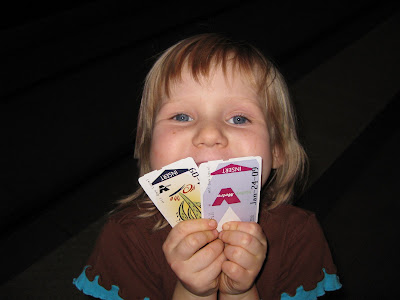
It definitely was NOT quicker, but it was a lot less hassle and the tickets were cheaper than parking. We paid $5 for two all-day passes for me and Brandi and $1.25 for an all-day pass for Joshua. Jacqueline (being under 6) was free. It took about 40 minutes to get downtown and since were were dropped off behind the stadium, we had to walk a bit to get there. Once inside, though, we had a great view of the action:
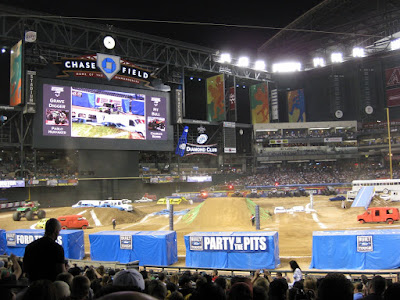
We stayed for the whole thing! I was worried that it'd take forever to get back on the train, but they had empty trains showing up ever couple of minutes to take people back. We were sitting down in about 5 minutes after leaving and I asked a kid on the train to take our picture:

Overall, a great time! The rest of my pictures, and Joshua's, will be posted on our SmugMug site soon.
Thanks,
Matt
We went to Monster Jam 2009 Saturday evening. We bought the tickets shortly after Monster Jam 2008 last January. Last year, I took Joshua and his friends Julia and Zach. This year, all four of us went. The adventure started right away since we decided to take Phoenix's new light rail downtown. Here's a picture of the Price 101 / Apache Road station, which is about 6 miles north of our house and where we parked our car.

Here's a picture of Jacqueline holding our tickets:

It definitely was NOT quicker, but it was a lot less hassle and the tickets were cheaper than parking. We paid $5 for two all-day passes for me and Brandi and $1.25 for an all-day pass for Joshua. Jacqueline (being under 6) was free. It took about 40 minutes to get downtown and since were were dropped off behind the stadium, we had to walk a bit to get there. Once inside, though, we had a great view of the action:

We stayed for the whole thing! I was worried that it'd take forever to get back on the train, but they had empty trains showing up ever couple of minutes to take people back. We were sitting down in about 5 minutes after leaving and I asked a kid on the train to take our picture:

Overall, a great time! The rest of my pictures, and Joshua's, will be posted on our SmugMug site soon.
Thanks,
Matt
Friday, January 23, 2009
A family that kicks together...
Hi!
I've been under the weather most of the week, so I've been a little slow to post. Tuesday evening, the kids started their Taekwondo training. We joined S&H Martial Arts. It feels like the right place for us: Good people, a nice facility, and a style we know and love. Here's a picture of the kids in their new uniforms and white belts.
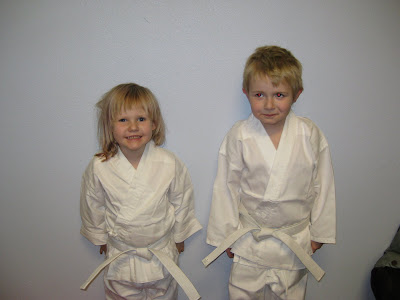
What made me feel that this school will work for us is that Jeff Nelson, the instructor from the Intel classes, is driving the curriculum at S&H and connecting them to his school in Minnesota.
Brandi and I still need to get our uniforms and learn the subtle differences between how we learned the forms and how they're taught at S&H, but that won't take long. We'll both be helping out and contributing where we can. It's a very open and supportive environment and I'm sure we'll be very happy there.
Thanks,
Matt
I've been under the weather most of the week, so I've been a little slow to post. Tuesday evening, the kids started their Taekwondo training. We joined S&H Martial Arts. It feels like the right place for us: Good people, a nice facility, and a style we know and love. Here's a picture of the kids in their new uniforms and white belts.

What made me feel that this school will work for us is that Jeff Nelson, the instructor from the Intel classes, is driving the curriculum at S&H and connecting them to his school in Minnesota.
Brandi and I still need to get our uniforms and learn the subtle differences between how we learned the forms and how they're taught at S&H, but that won't take long. We'll both be helping out and contributing where we can. It's a very open and supportive environment and I'm sure we'll be very happy there.
Thanks,
Matt
Tuesday, January 20, 2009
New Office
Hi!
Now that we have someone new (and better!) in the Oval Office, I thought I'd share some pictures of my new office. Here's a picture from the hallway:

The big grey box on the left is a filing cabinet. Eventually, I'll use a smaller laptop bag (e.g., the one I got from Thunderbird) and store it in the filing cabinet. Here's a picture of my desk area:
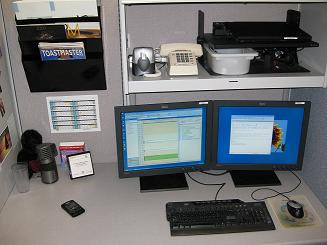
The overhead cabinet contains my headset, phone, and laptop with docking station. It locks so that I don't have to worry about locking the laptop to the dock. That white box (from IKEA) contains a USB hub where I can connect my iPod and USB keychain drive. To the left of the monitors, you see my BlackBerry, fan, stuffed monkey (from Brandi), plastic cup from the cafe, and Spanish page-a-day calendar. I put some photos on the side of the filing cabinet (not visible from the hall), but otherwise there is nothing on the walls.
Thanks,
Matt
Now that we have someone new (and better!) in the Oval Office, I thought I'd share some pictures of my new office. Here's a picture from the hallway:

The big grey box on the left is a filing cabinet. Eventually, I'll use a smaller laptop bag (e.g., the one I got from Thunderbird) and store it in the filing cabinet. Here's a picture of my desk area:

The overhead cabinet contains my headset, phone, and laptop with docking station. It locks so that I don't have to worry about locking the laptop to the dock. That white box (from IKEA) contains a USB hub where I can connect my iPod and USB keychain drive. To the left of the monitors, you see my BlackBerry, fan, stuffed monkey (from Brandi), plastic cup from the cafe, and Spanish page-a-day calendar. I put some photos on the side of the filing cabinet (not visible from the hall), but otherwise there is nothing on the walls.
Thanks,
Matt
Monday, January 19, 2009
The Staff of Religious Belief
Hi!
In my observation, religious belief is like a staff (big stick). Some people use it as a tool with which to keep stable on rough terrain, and to lend a hand to others. Others used it as a weapon with which to beat people. The problem is that there are so many who use it as a weapon (or at least there seems to be, perhaps they're just louder) that those who are using it as a tool can be misunderstood. I encourage anyone who has strong religious beliefs to focus on using them as a tool. The more this becomes the norm, the less power those wielding their beliefs will have...
Thanks!
Matt
In my observation, religious belief is like a staff (big stick). Some people use it as a tool with which to keep stable on rough terrain, and to lend a hand to others. Others used it as a weapon with which to beat people. The problem is that there are so many who use it as a weapon (or at least there seems to be, perhaps they're just louder) that those who are using it as a tool can be misunderstood. I encourage anyone who has strong religious beliefs to focus on using them as a tool. The more this becomes the norm, the less power those wielding their beliefs will have...
Thanks!
Matt
Sunday, January 18, 2009
The Madness of Multitasking
Hi!
I read an opinion piece in BusinessWeek titled “The Madness of Multitasking.” It’s a preview of a book titled Elsewhere, U.S.A. and it describes me perfectly. It was a bit of a shock, and an eye-opener. The premise is that our personal and professional lives have become so intertwined that we think of just hanging around with the kids as “wasting time.” For me, it goes a bit deeper. I’m practically obsessed with getting things done. I have pretty much EVERYTHING on my Outlook task list. When I get up in the morning, I’m faced with more things to do than I can possibly finish. The result is that I pick the low-hanging fruit (so to speak) and avoid the stuff that really matters. The goal seems to be checking off tasks, not actually accomplishing anything important. Here’s what I’m going to do:
1) I’m separating my work and home email. For a long time, I had my Cox email forwarded to my Intel account. This meant that I was constantly seeing personal email at work. Because of my obsession with keeping my Inbox empty (I rarely have more email in my Inbox than will fit on a screen.), I’m constantly checking and replying to email at work that has nothing to do with work. It made it impossible to focus on something for more than five minutes. My plan is to setup a rule at work that forwards anything that comes from an address NOT ending in @intel.com to home. This may be too simplistic, but it’ll be a start.
2) I’m separating personal (including school) and work tasks. This will get me to focus more on work while I’m at work, instead of being distracted by that personal task that’s generally easier (and more fun) to do… Having just reconfigured our desktop computer, I’m working on Brandi to use Outlook’s task features. My plan is not to draw her into my madness, but to help us work together on domestic tasks. For example, if “Put away laundry” is a shared task, then whichever one of us completes it will check it off and the other won’t see it. It’ll also help us see what the other has planned to do…
3) I may get rid of my BlackBerry. Here’s why I think that might help: I feel like the constant connectedness with work that it gives me provides me with an excuse to lose focus on work-related stuff: If someone really needs me, then they need only send email, right? Without it, I’ll have to leave work at work and be more focused while I’m there. I may just trade it in for a cheap cell phone so I can still have my desk phone forwarded.
The first two are pretty much a done deal. Whether I actually do get rid of my BB will depend a lot on how much my bill drops after recently changing plans...stay tuned!
Take care!
Matt
I read an opinion piece in BusinessWeek titled “The Madness of Multitasking.” It’s a preview of a book titled Elsewhere, U.S.A. and it describes me perfectly. It was a bit of a shock, and an eye-opener. The premise is that our personal and professional lives have become so intertwined that we think of just hanging around with the kids as “wasting time.” For me, it goes a bit deeper. I’m practically obsessed with getting things done. I have pretty much EVERYTHING on my Outlook task list. When I get up in the morning, I’m faced with more things to do than I can possibly finish. The result is that I pick the low-hanging fruit (so to speak) and avoid the stuff that really matters. The goal seems to be checking off tasks, not actually accomplishing anything important. Here’s what I’m going to do:
1) I’m separating my work and home email. For a long time, I had my Cox email forwarded to my Intel account. This meant that I was constantly seeing personal email at work. Because of my obsession with keeping my Inbox empty (I rarely have more email in my Inbox than will fit on a screen.), I’m constantly checking and replying to email at work that has nothing to do with work. It made it impossible to focus on something for more than five minutes. My plan is to setup a rule at work that forwards anything that comes from an address NOT ending in @intel.com to home. This may be too simplistic, but it’ll be a start.
2) I’m separating personal (including school) and work tasks. This will get me to focus more on work while I’m at work, instead of being distracted by that personal task that’s generally easier (and more fun) to do… Having just reconfigured our desktop computer, I’m working on Brandi to use Outlook’s task features. My plan is not to draw her into my madness, but to help us work together on domestic tasks. For example, if “Put away laundry” is a shared task, then whichever one of us completes it will check it off and the other won’t see it. It’ll also help us see what the other has planned to do…
3) I may get rid of my BlackBerry. Here’s why I think that might help: I feel like the constant connectedness with work that it gives me provides me with an excuse to lose focus on work-related stuff: If someone really needs me, then they need only send email, right? Without it, I’ll have to leave work at work and be more focused while I’m there. I may just trade it in for a cheap cell phone so I can still have my desk phone forwarded.
The first two are pretty much a done deal. Whether I actually do get rid of my BB will depend a lot on how much my bill drops after recently changing plans...stay tuned!
Take care!
Matt
Friday, January 16, 2009
Sure Things
Hi!
Imagine that it's January 30, 2008 and you're been told that your life depends on picking which of the following statements would be true in the next 12 months:
1) The New England Patriots would win the Super Bowl.
2) The Tampa Bay Rays would win the American League Pennant.
3) A black man would be elected President of the United States.
4) The Arizona Cardinals would play at HOME for the NFC Championship.
Wouldn't you have to have been TOTALLY INSANE not to pick #1? What is TOTALLY INSANE is that #1 is the only one that did NOT turn out to be true... Remember: In sports and in life, there's no such thing as a sure thing!!
Take care!
Matt
Imagine that it's January 30, 2008 and you're been told that your life depends on picking which of the following statements would be true in the next 12 months:
1) The New England Patriots would win the Super Bowl.
2) The Tampa Bay Rays would win the American League Pennant.
3) A black man would be elected President of the United States.
4) The Arizona Cardinals would play at HOME for the NFC Championship.
Wouldn't you have to have been TOTALLY INSANE not to pick #1? What is TOTALLY INSANE is that #1 is the only one that did NOT turn out to be true... Remember: In sports and in life, there's no such thing as a sure thing!!
Take care!
Matt
Thursday, January 15, 2009
Teacher of the Year
I've been giving a lot of thought recently to what it means to be a great teacher and the impact such teachers can have on the lives of their students. In September of 2004, I learned that my Readiness (between Kindergarten and First Grade) teacher had been named "Teacher of the Year" in my home town. We had gone to see him in 2003. Here's a picture of him with me holding Joshua:

Here's the text of a Letter to the Editor that was published in the Cheshire Herald that same September:
I recently learned that Tim Granucci was named “Teacher of the Year” in Cheshire and had to share feelings about him with your readers. I graduated from Cheshire High School in 1991 and was in Mr. Granucci’s Readiness class at Highland Elementary School during the 1978-1979 school year. Robert Fulghum wrote that all he really needed to know he learned in Kindergarten. For me, it was Readiness. That year, Mr. Granucci taught me, among other things, the importance of playing well with others, that trying new things may not always be fun but it’s always interesting, and how to tie my shoes. The first two have served me very well in the 25 years since I left his classroom. The third actually lost some of its usefulness for a while during the Velcro-sneaker craze, but became important again after I stopped wearing Keds. But it was so much more than that.
I now work as a senior circuit design engineer at Intel in Arizona and have traveled a long road to get here. I’ve had many teachers in my 21 years of formal schooling (BS, MS, MBA), and with all due respect to the brilliant professors I had in undergraduate and graduate school, none of them could hold a candle to Mr. Granucci. His ability to capture the minds and hearts of his students was amazing! He never thought of himself as too authoritative to admit when he was wrong, too superior to laugh at something silly, or too dignified to get down on the floor and see things from our perspective. (He told me, when I visited him last year with my wife and son, that is one of the reasons he had to stop teaching Readiness!) He had our respect, because he was willing to earn it.
In Mr. Granucci’s classroom, knowledge wasn’t some dull fluid to be poured into the empty vessels that were our heads; it was something wonderful to be shared and integrated into our thoughts and experiences. Discovery wasn’t something done only by old world explorers in history books; it was the act of making the great big world of a six-year-old just a little bit smaller every single day. And learning wasn’t the “work” we did while we were in school; it was the process by which we realized our potential as citizens and human beings! In short, he instilled in me a life-long love of knowledge, discovery, and learning that carried me through some of the inevitable rough patches of my academic career. For that, I will be forever grateful to him.
I’m happy for him for having received this honor because he is so deserving of it. Because he is so deserving, though, I’m sure that he is just as honored knowing that he has had such a positive and long-lasting impact on one his students – though I suspect, many more. In Cheshire, he may be “Teacher of the Year” but in my heart he is the teacher of a lifetime.

Here's the text of a Letter to the Editor that was published in the Cheshire Herald that same September:
I recently learned that Tim Granucci was named “Teacher of the Year” in Cheshire and had to share feelings about him with your readers. I graduated from Cheshire High School in 1991 and was in Mr. Granucci’s Readiness class at Highland Elementary School during the 1978-1979 school year. Robert Fulghum wrote that all he really needed to know he learned in Kindergarten. For me, it was Readiness. That year, Mr. Granucci taught me, among other things, the importance of playing well with others, that trying new things may not always be fun but it’s always interesting, and how to tie my shoes. The first two have served me very well in the 25 years since I left his classroom. The third actually lost some of its usefulness for a while during the Velcro-sneaker craze, but became important again after I stopped wearing Keds. But it was so much more than that.
I now work as a senior circuit design engineer at Intel in Arizona and have traveled a long road to get here. I’ve had many teachers in my 21 years of formal schooling (BS, MS, MBA), and with all due respect to the brilliant professors I had in undergraduate and graduate school, none of them could hold a candle to Mr. Granucci. His ability to capture the minds and hearts of his students was amazing! He never thought of himself as too authoritative to admit when he was wrong, too superior to laugh at something silly, or too dignified to get down on the floor and see things from our perspective. (He told me, when I visited him last year with my wife and son, that is one of the reasons he had to stop teaching Readiness!) He had our respect, because he was willing to earn it.
In Mr. Granucci’s classroom, knowledge wasn’t some dull fluid to be poured into the empty vessels that were our heads; it was something wonderful to be shared and integrated into our thoughts and experiences. Discovery wasn’t something done only by old world explorers in history books; it was the act of making the great big world of a six-year-old just a little bit smaller every single day. And learning wasn’t the “work” we did while we were in school; it was the process by which we realized our potential as citizens and human beings! In short, he instilled in me a life-long love of knowledge, discovery, and learning that carried me through some of the inevitable rough patches of my academic career. For that, I will be forever grateful to him.
I’m happy for him for having received this honor because he is so deserving of it. Because he is so deserving, though, I’m sure that he is just as honored knowing that he has had such a positive and long-lasting impact on one his students – though I suspect, many more. In Cheshire, he may be “Teacher of the Year” but in my heart he is the teacher of a lifetime.
Wednesday, January 14, 2009
Parts of Speech
Hi!
This post will be about the parts of speech. No, I don't mean nouns, verbs, adverbs, and adjectives. I mean introduction, opening, body, and conclusion. Each part has an important role to play and they all work together to achieve your goal.
To read the rest of the post, click here.
Thanks,
Matt
This post will be about the parts of speech. No, I don't mean nouns, verbs, adverbs, and adjectives. I mean introduction, opening, body, and conclusion. Each part has an important role to play and they all work together to achieve your goal.
To read the rest of the post, click here.
Thanks,
Matt
Parts of Speech
Hi!
This post will be about the parts of speech. No, I don't mean nouns, verbs, adverbs, and adjectives. I mean introduction, opening, body, and conclusion. Each part has an important role to play and they all work together to achieve your goal.
Introduction
The introduction is what is said about the speaker by someone else before the speaker takes the stage. The introduction should be used to establish credibility and provide necessary background information. It is assumed that the "someone else" has credibility with the audience. Perhaps this person is a manager who invited you to present, or the emcee of the event. By having this person "toot your horn," the audience will be more likely to accept you an an expert. If the introduction provides the necessary background information, then the opening can have a greater impact.
Opening
The opening should being with an impact to draw the audience in. This can be done with a great quote, a question, or a bold statement. Choose something appropriate for the topic and use it to ensure that the audience gets engaged right away. The next part of the opening should be to give the audience a preview of your topic. The old saying, "Tell 'em what you're going to tell 'em, tell 'em, then tell 'em what you told 'em" is right on. It may seem repetitive to you, but people remember what they hear several times.
Body
The body is where you get into the details of your main points. Regardless of how long your speech is, you should never have more than a few main points. Longer speeches just have more detail or discussion. Too many main points and you dilute the importance of each. Focus on what's most important to the conclusion you want to draw, or what will be most controversial if you're trying to generate discussion. That which is trivial and/or non-controversial can be mentioned briefly.
Conclusion
The conclusion is where you wrap things up by "telling 'em what you told 'em" and make your call to action. Unless your speech is an oral report, you should always have a call to action. This could be asking for approval or a commitment by others to act in a certain way. If your presentation is part of a larger meeting, ensure the results of the call to action are capture in the meeting minutes.
All four of these parts work together to make your speech and they're like links in a chain. You speech will only as strong as the weakest link...
Thanks,
Matt
This post will be about the parts of speech. No, I don't mean nouns, verbs, adverbs, and adjectives. I mean introduction, opening, body, and conclusion. Each part has an important role to play and they all work together to achieve your goal.
Introduction
The introduction is what is said about the speaker by someone else before the speaker takes the stage. The introduction should be used to establish credibility and provide necessary background information. It is assumed that the "someone else" has credibility with the audience. Perhaps this person is a manager who invited you to present, or the emcee of the event. By having this person "toot your horn," the audience will be more likely to accept you an an expert. If the introduction provides the necessary background information, then the opening can have a greater impact.
Opening
The opening should being with an impact to draw the audience in. This can be done with a great quote, a question, or a bold statement. Choose something appropriate for the topic and use it to ensure that the audience gets engaged right away. The next part of the opening should be to give the audience a preview of your topic. The old saying, "Tell 'em what you're going to tell 'em, tell 'em, then tell 'em what you told 'em" is right on. It may seem repetitive to you, but people remember what they hear several times.
Body
The body is where you get into the details of your main points. Regardless of how long your speech is, you should never have more than a few main points. Longer speeches just have more detail or discussion. Too many main points and you dilute the importance of each. Focus on what's most important to the conclusion you want to draw, or what will be most controversial if you're trying to generate discussion. That which is trivial and/or non-controversial can be mentioned briefly.
Conclusion
The conclusion is where you wrap things up by "telling 'em what you told 'em" and make your call to action. Unless your speech is an oral report, you should always have a call to action. This could be asking for approval or a commitment by others to act in a certain way. If your presentation is part of a larger meeting, ensure the results of the call to action are capture in the meeting minutes.
All four of these parts work together to make your speech and they're like links in a chain. You speech will only as strong as the weakest link...
Thanks,
Matt
Monday, January 12, 2009
Nintendo Wii
Hi!
When I was a kid, playing video games all day meant cramped legs, a strained neck, and sore thumbs. My times have changed! Here's a video of Joshua playing Super Smash Bros. Brawl on our Nintendo Wii:
He jumps around for hours like this. In the video you can see him wipe his brow and I've seen him practically collapse after a long "battle."
I'm getting a lot out of using the Wii Fit. There's a balance game called "Lotus Focus" that requires me to sit perfectly still for three minutes. I can't sit in the lotus position, but it's still a challenge even with my legs crossed in front of me. The balance board senses if I don't stay still and a loud "CUT!!" lets me know.
The yoga and aerobics are great! Once we get back to martial arts training (more on this tomorrow), we'll have to find a way to work them all in but it'll be worth it. The Wii Fit is fun and it's unlike any video game I've ever played...I actually feel like I accomplish something by playing it!
Take care!
Matt
When I was a kid, playing video games all day meant cramped legs, a strained neck, and sore thumbs. My times have changed! Here's a video of Joshua playing Super Smash Bros. Brawl on our Nintendo Wii:
He jumps around for hours like this. In the video you can see him wipe his brow and I've seen him practically collapse after a long "battle."
I'm getting a lot out of using the Wii Fit. There's a balance game called "Lotus Focus" that requires me to sit perfectly still for three minutes. I can't sit in the lotus position, but it's still a challenge even with my legs crossed in front of me. The balance board senses if I don't stay still and a loud "CUT!!" lets me know.
The yoga and aerobics are great! Once we get back to martial arts training (more on this tomorrow), we'll have to find a way to work them all in but it'll be worth it. The Wii Fit is fun and it's unlike any video game I've ever played...I actually feel like I accomplish something by playing it!
Take care!
Matt
Sunday, January 11, 2009
Fixing Football
Hi!
I promise this won't become a sports blog that occasionally touches on other topics. However, football has been on my mind lately. I'm not a huge fan, but have been to two (college bowl) games in the past couple of weeks. (These are the only two games I've seen in years.)
It seems that every January there is an argument about the BCS. When the argument is about which team is the best at the end of the year, a play-off makes sense. When the bigger picture is considered, meaning the quality of the regular season and the fact that bowls allow a lot of teams to end their season with a win, things get a bit fuzzy.
In the NFL this weekend, I'm rooting for San Diego. I'm glad that Arizona won. I'm rooting for Philly because I'd love for the NFC Championship to be in Glendale. I'd LOVE to see the Cardinals and the Chargers play in the Super Bowl. THIS, the 8-8 Chargers versus the 9-7 Cardinals, would be an argument AGAINST a play-off. What's the point of busting your butt all season for a top seed if you can back into the play-offs and still win your Conference?
What's the solution? For college, I don't know. I think all the money football factory schools make is a problem and spreading it around should be a goal of whatever system is used. Adding a couple of weeks to the season would make it impossible for some schools to participate because some have rules that prohibit playing after the start of the spring semester. Shortening the season would mean a LOT fewer games over all. For a LOT of writing on college football, see the writing of Gregg Easterbrook on ESPN.com. He covers the issue well.
For the NFL, just get rid of the Divisions and Conferences. This would mean that the best team in a weak Division wouldn't get any advantage. It would also mean that good teams in strong Divisions wouldn't be penalized. Schedules could be more balanced. At the end of the season, the top 12 or 16 teams would play in a seeded tournament. It's simple and could lead to a MUCH more interesting Super Bowl...
Take care!
Matt
I promise this won't become a sports blog that occasionally touches on other topics. However, football has been on my mind lately. I'm not a huge fan, but have been to two (college bowl) games in the past couple of weeks. (These are the only two games I've seen in years.)
It seems that every January there is an argument about the BCS. When the argument is about which team is the best at the end of the year, a play-off makes sense. When the bigger picture is considered, meaning the quality of the regular season and the fact that bowls allow a lot of teams to end their season with a win, things get a bit fuzzy.
In the NFL this weekend, I'm rooting for San Diego. I'm glad that Arizona won. I'm rooting for Philly because I'd love for the NFC Championship to be in Glendale. I'd LOVE to see the Cardinals and the Chargers play in the Super Bowl. THIS, the 8-8 Chargers versus the 9-7 Cardinals, would be an argument AGAINST a play-off. What's the point of busting your butt all season for a top seed if you can back into the play-offs and still win your Conference?
What's the solution? For college, I don't know. I think all the money football factory schools make is a problem and spreading it around should be a goal of whatever system is used. Adding a couple of weeks to the season would make it impossible for some schools to participate because some have rules that prohibit playing after the start of the spring semester. Shortening the season would mean a LOT fewer games over all. For a LOT of writing on college football, see the writing of Gregg Easterbrook on ESPN.com. He covers the issue well.
For the NFL, just get rid of the Divisions and Conferences. This would mean that the best team in a weak Division wouldn't get any advantage. It would also mean that good teams in strong Divisions wouldn't be penalized. Schedules could be more balanced. At the end of the season, the top 12 or 16 teams would play in a seeded tournament. It's simple and could lead to a MUCH more interesting Super Bowl...
Take care!
Matt
Friday, January 09, 2009
A Tribute to Robert F. Jones
Robert F. Jones, my grandfather, died a year ago tonight. As a tribute to him, here's a picture of him with my son, Joshua:

And here's the text of the speech I gave at his funeral, which was held in Memphis, Tennessee on Saturday, January 12, 2007:
Good morning. Thank you all for being here today. Since I don't really know many of you, I'd like to take a poll before I go on. How many of you have known Robert Jones for 15 years or more? How about 25 years? 35 years? Wow! Thank you! You see, 35 years ago I was the sick baby who needed your prayers and thanks to my grandfather, you came through for me. Of course it's an honor for me to be here today, but if you'd seen me 35 years ago you'd also say it's a miracle.
Now, I live in Arizona with my wife of nine years, Brandi, and our children, Joshua, age 6, and Jacqueline, age 4. Brandi was able to be with us today, but our children are staying with friends. I was fortunate in that my kids were able to get to know my granddaddy which means that this past week was also hard for them, too.
Wednesday evening, Joshua was sitting on my bed crying like the little boy that he is. He said, "I want to see great-granddaddy again." I sat down next to him on the bed and held him in my arms. I told him to take a deep breath and close his eyes. Then, I told him to picture his great-granddaddy clearly in his mind, which he can do because we have pictures of him around the house. After he'd done this I said, "Joshua, as long as you can picture him in your mind, you always be able to see him."
I released Joshua with my right arm and put it around Jacqueline. She said that great-grama must be sad. One of her best friend's grandmothers succomed to cancer relatively recently, so she seems to understand the sadness associated with that kind of loss. I told her that we're all sad because we all love him. Then, my four-year old daughter looked me in the eye and said, "Tell great-grama that I'll never, ever forget him."
I've spent the last couple of nights in his room in my grandparents' townhouse. It was a comforting feeling because his presence is everywhere. I don't mean that in a supernatural sense. The room has the pictures that I know were special to him. There is a stack of Sunday Prayer Bulletins on his bedside table; the latest of which is dated December 30th, 2007. There are also eight clocks in the room...all set to the exact same time!
His legacy is much more than pictures, papers, and synchonized time pieces, though. I feel my grandfather's legacy whenever I feel my father's unconditional love. I hear my grandfather's legacy whenever I hear my brother's quick wit. And I see my grandfather's legacy whenver I see my son's protruding ears.
Those we love are never truly gone. Like I told my son, as long as I can picture him in my mind, I'll always be able to see him. And like my daughter, I'll never, ever forget him. Thank you.

And here's the text of the speech I gave at his funeral, which was held in Memphis, Tennessee on Saturday, January 12, 2007:
Good morning. Thank you all for being here today. Since I don't really know many of you, I'd like to take a poll before I go on. How many of you have known Robert Jones for 15 years or more? How about 25 years? 35 years? Wow! Thank you! You see, 35 years ago I was the sick baby who needed your prayers and thanks to my grandfather, you came through for me. Of course it's an honor for me to be here today, but if you'd seen me 35 years ago you'd also say it's a miracle.
Now, I live in Arizona with my wife of nine years, Brandi, and our children, Joshua, age 6, and Jacqueline, age 4. Brandi was able to be with us today, but our children are staying with friends. I was fortunate in that my kids were able to get to know my granddaddy which means that this past week was also hard for them, too.
Wednesday evening, Joshua was sitting on my bed crying like the little boy that he is. He said, "I want to see great-granddaddy again." I sat down next to him on the bed and held him in my arms. I told him to take a deep breath and close his eyes. Then, I told him to picture his great-granddaddy clearly in his mind, which he can do because we have pictures of him around the house. After he'd done this I said, "Joshua, as long as you can picture him in your mind, you always be able to see him."
I released Joshua with my right arm and put it around Jacqueline. She said that great-grama must be sad. One of her best friend's grandmothers succomed to cancer relatively recently, so she seems to understand the sadness associated with that kind of loss. I told her that we're all sad because we all love him. Then, my four-year old daughter looked me in the eye and said, "Tell great-grama that I'll never, ever forget him."
I've spent the last couple of nights in his room in my grandparents' townhouse. It was a comforting feeling because his presence is everywhere. I don't mean that in a supernatural sense. The room has the pictures that I know were special to him. There is a stack of Sunday Prayer Bulletins on his bedside table; the latest of which is dated December 30th, 2007. There are also eight clocks in the room...all set to the exact same time!
His legacy is much more than pictures, papers, and synchonized time pieces, though. I feel my grandfather's legacy whenever I feel my father's unconditional love. I hear my grandfather's legacy whenever I hear my brother's quick wit. And I see my grandfather's legacy whenver I see my son's protruding ears.
Those we love are never truly gone. Like I told my son, as long as I can picture him in my mind, I'll always be able to see him. And like my daughter, I'll never, ever forget him. Thank you.
Wednesday, January 07, 2009
Visiting Martial Arts Schools
Hi!
We visited the Ja Shin Do school again last night, but this time took class. Great workout!! Grand Master Bauman is a firm believer in physical conditioning and the soreness we're feeling today is testament. Brandi and I felt very comfortable there, not so much with the kids. Jacqueline participated some; Joshua, not at all. We think Joshua wants the experience to be more like what his friends have where they go. (He attended a karate-themed birthday party for one of his friends at his school.)
We visited another school tonight, S&H (formerly Stevens) Family Karate. Their web site is here. This school evolved from Mike Erickson's America's Best Karate, where Brandi and I met and first trained in TKD together. They teach the traditional TKD forms, and while this may seem like a violation of one of my criteria, it's something we may be willing to overlook.
When Brandi and I started our own family, we always figured that our kids would eventually be enrolled in a martial arts program. We also always figured that it'd be at a school where we were already training, and perhaps even teaching. After we left Choi's, we got it into our heads that we'd start from scratch as a family in a completely new style. While I'd love to do this, I'm not sure it's practical. A school that has a beginner's program that would be engaging and challenging to Brandi and I (who have nearly three decades of training experience between us), would probably be inappropriate for the kids. A school that is kid-focused (like where some of his friends train), would be inappropriate for us. The only solution is a school where the kids can start as beginners, and she and I can continue as black belts. This is only possible in a traditional TKD school.
We haven't made up our minds, yet, but this is what we're thinking...
Thanks,
Matt
We visited the Ja Shin Do school again last night, but this time took class. Great workout!! Grand Master Bauman is a firm believer in physical conditioning and the soreness we're feeling today is testament. Brandi and I felt very comfortable there, not so much with the kids. Jacqueline participated some; Joshua, not at all. We think Joshua wants the experience to be more like what his friends have where they go. (He attended a karate-themed birthday party for one of his friends at his school.)
We visited another school tonight, S&H (formerly Stevens) Family Karate. Their web site is here. This school evolved from Mike Erickson's America's Best Karate, where Brandi and I met and first trained in TKD together. They teach the traditional TKD forms, and while this may seem like a violation of one of my criteria, it's something we may be willing to overlook.
When Brandi and I started our own family, we always figured that our kids would eventually be enrolled in a martial arts program. We also always figured that it'd be at a school where we were already training, and perhaps even teaching. After we left Choi's, we got it into our heads that we'd start from scratch as a family in a completely new style. While I'd love to do this, I'm not sure it's practical. A school that has a beginner's program that would be engaging and challenging to Brandi and I (who have nearly three decades of training experience between us), would probably be inappropriate for the kids. A school that is kid-focused (like where some of his friends train), would be inappropriate for us. The only solution is a school where the kids can start as beginners, and she and I can continue as black belts. This is only possible in a traditional TKD school.
We haven't made up our minds, yet, but this is what we're thinking...
Thanks,
Matt
Tuesday, January 06, 2009
Fiesta Bowl
Hi!
Brandi and I went to the Fiesta Bowl last night between UT and OSU. Great game! You can read the details on ESPN's web site, so I won't get into them here. I'm sure you're wondering how we got tickets to such a game. Well, my association with Desert Sun has results in the acquisition of more than cockroaches. One of the parents is the CFO of the Fiesta Bowl and donated a bunch of tickets to the school. The Directors, in their infinite wisdom and charity, offered them to faculty, staff, and board members. Accepting a pair was a no-brainer. Many thanks to my mother and grandmother for watching the kids... Anyway, here's a picture I took of the field:

There was a lot of traffic, so we were a bit late. We missed the first two minutes or so of the first quarter, but didn't miss much. The first half was pretty lame. By way of comparison, had we missed the first two minutes of the Insight Bowl on New Year's Eve, we'd have missed two touchdowns! By the end of the first half, only three FGs had been scored. Both offenses really seemed to struggle. During halftime, both bands played. Here's a video of the OSU band:
The main reason I show this video is because shooting it totally drained my battery, so I had no juice to take anything as the game went down to the wire. I had only charged the battery once after receiving the camera as a gift from Brandi for Christmas. I should have charged it. Oh well... I was hoping to record a game-winning FG. At least the TDs late in the fourth were a bit of a surprise, so there's no way I could have anticipated them and had the camera going. The best way I can describe the end of the game is that "Texas snatched defeat from the jaws of victory, then shoved it back down its throat." I swear the UT fans in front of us threw up over the rail when OSU scored a TD with two minutes left, then the OSU fans did the same when UT scored a TD with :26 left.
The guy next to me seemed to know as much as I do about football, but that's not saying much. However, when OSU was driving down the field toward the end, we were talking about time management. It really didn't seem that OSU was planning to get the ball back. They had a 2nd and 2 at the UT 15 when they ran for the TD. Had they gotten the first down and used more time on a few more plays before a score, they'd have taken the lead with only a few seconds left. After the run, Brandi asked me whether two minutes was enough for UT to score a TD. I said, "Sure, it happens all the time." Sure enough, it happened last night.
Take care!
Matt
Brandi and I went to the Fiesta Bowl last night between UT and OSU. Great game! You can read the details on ESPN's web site, so I won't get into them here. I'm sure you're wondering how we got tickets to such a game. Well, my association with Desert Sun has results in the acquisition of more than cockroaches. One of the parents is the CFO of the Fiesta Bowl and donated a bunch of tickets to the school. The Directors, in their infinite wisdom and charity, offered them to faculty, staff, and board members. Accepting a pair was a no-brainer. Many thanks to my mother and grandmother for watching the kids... Anyway, here's a picture I took of the field:

There was a lot of traffic, so we were a bit late. We missed the first two minutes or so of the first quarter, but didn't miss much. The first half was pretty lame. By way of comparison, had we missed the first two minutes of the Insight Bowl on New Year's Eve, we'd have missed two touchdowns! By the end of the first half, only three FGs had been scored. Both offenses really seemed to struggle. During halftime, both bands played. Here's a video of the OSU band:
The main reason I show this video is because shooting it totally drained my battery, so I had no juice to take anything as the game went down to the wire. I had only charged the battery once after receiving the camera as a gift from Brandi for Christmas. I should have charged it. Oh well... I was hoping to record a game-winning FG. At least the TDs late in the fourth were a bit of a surprise, so there's no way I could have anticipated them and had the camera going. The best way I can describe the end of the game is that "Texas snatched defeat from the jaws of victory, then shoved it back down its throat." I swear the UT fans in front of us threw up over the rail when OSU scored a TD with two minutes left, then the OSU fans did the same when UT scored a TD with :26 left.
The guy next to me seemed to know as much as I do about football, but that's not saying much. However, when OSU was driving down the field toward the end, we were talking about time management. It really didn't seem that OSU was planning to get the ball back. They had a 2nd and 2 at the UT 15 when they ran for the TD. Had they gotten the first down and used more time on a few more plays before a score, they'd have taken the lead with only a few seconds left. After the run, Brandi asked me whether two minutes was enough for UT to score a TD. I said, "Sure, it happens all the time." Sure enough, it happened last night.
Take care!
Matt
Monday, January 05, 2009
Hissy and Chippy
Hi!
Yesterday, I promised a post on our cockroaches, so here it is. Joshua's Kindergarten class at Desert Sun had Madagascar hissing cockroaches as class pets. When one had babies, the teacher offered the progeny to the students. Joshua (and Jacqueline) both thought this was a great opportunity to expand the menagerie that is our household. At first, I balked. I mean, who wants to welcome cockroaches into their home? Joshua made a good case, though: He said that they're not vermin because they're pets and they don't have diseases because they were born in captivity. I relented. Joshua's is named Hissy and Jacqueline's is Chippy. Here's a photo of their habitats:

Here's a close-up of Chippy:

Hissy likes to hang out right under the lid, so I couldn't get a good picture of him. I assume (and let the kids assume) that Joshua's is male and Jacqueline's is female. This justifies our keeping them separate. In fact, we have no idea but don't want to take a chance. The Wikipedia site explains how to tell male from female, but I'd still prefer not to take a chance.
One nice thing about cockroaches is they're hearty pets, as you might expect. The kids totally ignored them for a couple of months and with a little water and food, they bounced right back. Two days of the same treatment would kill most fish. Of course, "pet" is not what we do with them...but that's also true of fish. In a future post, I'll introduce our real "pets."
Thanks,
Matt
Yesterday, I promised a post on our cockroaches, so here it is. Joshua's Kindergarten class at Desert Sun had Madagascar hissing cockroaches as class pets. When one had babies, the teacher offered the progeny to the students. Joshua (and Jacqueline) both thought this was a great opportunity to expand the menagerie that is our household. At first, I balked. I mean, who wants to welcome cockroaches into their home? Joshua made a good case, though: He said that they're not vermin because they're pets and they don't have diseases because they were born in captivity. I relented. Joshua's is named Hissy and Jacqueline's is Chippy. Here's a photo of their habitats:

Here's a close-up of Chippy:

Hissy likes to hang out right under the lid, so I couldn't get a good picture of him. I assume (and let the kids assume) that Joshua's is male and Jacqueline's is female. This justifies our keeping them separate. In fact, we have no idea but don't want to take a chance. The Wikipedia site explains how to tell male from female, but I'd still prefer not to take a chance.
One nice thing about cockroaches is they're hearty pets, as you might expect. The kids totally ignored them for a couple of months and with a little water and food, they bounced right back. Two days of the same treatment would kill most fish. Of course, "pet" is not what we do with them...but that's also true of fish. In a future post, I'll introduce our real "pets."
Thanks,
Matt
Sunday, January 04, 2009
Dad's 64th Birthday
Hi!
My post about cockroaches is going to have to wait because today is my father's 64th birthday. Brandi, the kids, and I got him a gift certificate for a restaurant in downtown Chandler. We figured he can use it before the Oak Ridge Boys concert (for which we got him tickets for Christmas).
My brother, Tad, his wife, Mirela, and their son, Alex, got him a nice frame with a picture of him with Alex and a copy of The Beatles' Sgt. Pepper CD. This is the one with "When I'm Sixty-Four" on it. I'm sure that my brother has been planning this for years, if not decades.
We met at Marie Calendar's for pie. (They had a large, late lunch and weren't interested in dinner.) It worked out well. Here's a video of our singing:
He's done a lot in his 64 years and has plans to do a lot more. Here's to many more, Pop, we love you!
Thanks,
Matt
My post about cockroaches is going to have to wait because today is my father's 64th birthday. Brandi, the kids, and I got him a gift certificate for a restaurant in downtown Chandler. We figured he can use it before the Oak Ridge Boys concert (for which we got him tickets for Christmas).
My brother, Tad, his wife, Mirela, and their son, Alex, got him a nice frame with a picture of him with Alex and a copy of The Beatles' Sgt. Pepper CD. This is the one with "When I'm Sixty-Four" on it. I'm sure that my brother has been planning this for years, if not decades.
We met at Marie Calendar's for pie. (They had a large, late lunch and weren't interested in dinner.) It worked out well. Here's a video of our singing:
He's done a lot in his 64 years and has plans to do a lot more. Here's to many more, Pop, we love you!
Thanks,
Matt
Saturday, January 03, 2009
I Love My Kids!
Hi!
This may seem like something that doesn't need saying, but here it goes: I love my kids! I don't just mean in the parental way, but I really do love being around them. My seven-year old son, Joshua, is a great kid! Since we got our Wii for Christmas, he's spent a LOT of time playing it. I love that he cares enough to be frustrated...and enough to keep trying until he gets it. Sometimes, his mom or I will help him, but I know he prefers to do it on his own. This morning, he and I were playing an Avatar game. I get bored with the game rather quickly, but don't get bored watching his excitement as we work together toward common goals.
My five-year old daughter, Jacqueline, is also a great kid! She's VERY active wants to be a singer/dancer when she grows up. (These are two skills she most definitely will NOT inherit from her father.) Here's a video of her showing off her new Kung Fu Panda headband.
She likes to make up songs and perform them in front of friends and family. Not casually, though, she wants it to be a big production. I'll have to start recording those for YouTube posting, too.
Being a father is a lot of work. I try do right by my kids. I'm not perfect, but they know I'm trying. When I mess up, I apologize. I don't think pretending to be perfect is setting the right example, so I'll just be human...and I'll love them for being human, too.
Take care!
Matt
This may seem like something that doesn't need saying, but here it goes: I love my kids! I don't just mean in the parental way, but I really do love being around them. My seven-year old son, Joshua, is a great kid! Since we got our Wii for Christmas, he's spent a LOT of time playing it. I love that he cares enough to be frustrated...and enough to keep trying until he gets it. Sometimes, his mom or I will help him, but I know he prefers to do it on his own. This morning, he and I were playing an Avatar game. I get bored with the game rather quickly, but don't get bored watching his excitement as we work together toward common goals.
My five-year old daughter, Jacqueline, is also a great kid! She's VERY active wants to be a singer/dancer when she grows up. (These are two skills she most definitely will NOT inherit from her father.) Here's a video of her showing off her new Kung Fu Panda headband.
She likes to make up songs and perform them in front of friends and family. Not casually, though, she wants it to be a big production. I'll have to start recording those for YouTube posting, too.
Being a father is a lot of work. I try do right by my kids. I'm not perfect, but they know I'm trying. When I mess up, I apologize. I don't think pretending to be perfect is setting the right example, so I'll just be human...and I'll love them for being human, too.
Take care!
Matt
Friday, January 02, 2009
Resolution Number One
New Year's Resolution
Hi!
One of my New Year's Resolutions is to get back into martial arts as a family activity. Last year, I trained briefly with some folks at Intel in the gym in OC2. They're good folks and I enjoyed my time with them, but I didn't feel it was a long term solution to my problem. The problem, of course, is that I needed to have somewhere to train on a regular basis and I really wanted it to be with my family.
We did some thinking and established some criteria that a school would have to meet in order for it to be a solution to our (no longer just "my") problem. First, it'd have to be a style that we all could enjoy and would help us to grow. Unofficially, this ruled out TKD since we wanted to feel like we were all going to start at the same level. Second, it'd have to have classes that allow us to train at basically the same time. We didn't want a school with a schedule that would require us to go there at certain times for the kids, and certain other times for the adults. The classes didn't have to be mixed, but they couldn't be so disjoint that it'd be a hassle. Third, we know Joshua will want to train with weapons, so we'd like to find a school that has some weapons training in the curriculum. Of course, the usual criteria apply as well: good facilities, nice people, reasonable tuition rates, competent instructors. We narrowed our choice down to three schools:
Ja Shin Do
Isshinryu Karate
Hung Fa Yi Wing Chun
All three schools meet the usual criteria. Isshinryu Karate might seem to violate the first based on the same reasons that we unofficially ruled out TKD (I'm already a black belt in Isshinyu), but since it has been so long I'd feel like I was starting over anyway. We still haven't made up our mind, but are planning to visit the Ja Shin Do school next week to try a class. I'll post again after our visit...
Thanks,
Matt
One of my New Year's Resolutions is to get back into martial arts as a family activity. Last year, I trained briefly with some folks at Intel in the gym in OC2. They're good folks and I enjoyed my time with them, but I didn't feel it was a long term solution to my problem. The problem, of course, is that I needed to have somewhere to train on a regular basis and I really wanted it to be with my family.
We did some thinking and established some criteria that a school would have to meet in order for it to be a solution to our (no longer just "my") problem. First, it'd have to be a style that we all could enjoy and would help us to grow. Unofficially, this ruled out TKD since we wanted to feel like we were all going to start at the same level. Second, it'd have to have classes that allow us to train at basically the same time. We didn't want a school with a schedule that would require us to go there at certain times for the kids, and certain other times for the adults. The classes didn't have to be mixed, but they couldn't be so disjoint that it'd be a hassle. Third, we know Joshua will want to train with weapons, so we'd like to find a school that has some weapons training in the curriculum. Of course, the usual criteria apply as well: good facilities, nice people, reasonable tuition rates, competent instructors. We narrowed our choice down to three schools:
All three schools meet the usual criteria. Isshinryu Karate might seem to violate the first based on the same reasons that we unofficially ruled out TKD (I'm already a black belt in Isshinyu), but since it has been so long I'd feel like I was starting over anyway. We still haven't made up our mind, but are planning to visit the Ja Shin Do school next week to try a class. I'll post again after our visit...
Thanks,
Matt
Thursday, January 01, 2009
New Year's Resolutions
Welcome!
The purpose of this blog is to give me a forum to publish whatever is on my mind. I have a blog that I use for Presentation Skills, and one that I use for martial arts, but not one for general thoughts. Posts to this blog will automatically be sent to a Yahoo! group. I've set it up so that anyone can join, so if you're intersted in what's on my mind, please feel free to join.
Since today is the first of the year 2009, I thought I'd write about New Year's Resolutions. My resolutions for this year are:
Get back into martial arts as a family activity.
Successfully complete my courses at Thunderbird.
Establish better communication with friends and family.
Establish and maintain good exercise and financial habits.
This blog relates to the third resolution. I've also created a family blog, though I haven't yet discussed that with Brandi. I also posted some videos on a new YouTube account, though that might be replaced by an upgrade to our SmugMug account. The first resolution relates to the fourth resolution.
My plan is to post at least four times per week. (Every day would be ideal, but I'm trying to be realistic.) If I have a post that really belongs on one of my other blogs, I'll post it there and link to it from here.
Happy New Year!
Matt Jones
http://www.mattdtm.com
The purpose of this blog is to give me a forum to publish whatever is on my mind. I have a blog that I use for Presentation Skills, and one that I use for martial arts, but not one for general thoughts. Posts to this blog will automatically be sent to a Yahoo! group. I've set it up so that anyone can join, so if you're intersted in what's on my mind, please feel free to join.
Since today is the first of the year 2009, I thought I'd write about New Year's Resolutions. My resolutions for this year are:
This blog relates to the third resolution. I've also created a family blog, though I haven't yet discussed that with Brandi. I also posted some videos on a new YouTube account, though that might be replaced by an upgrade to our SmugMug account. The first resolution relates to the fourth resolution.
My plan is to post at least four times per week. (Every day would be ideal, but I'm trying to be realistic.) If I have a post that really belongs on one of my other blogs, I'll post it there and link to it from here.
Happy New Year!
Matt Jones
http://www.mattdtm.com
Monday, August 11, 2008
Speed Breathing
No, I don't mean breathing as fast as you can... What I mean is breathing for speed. Lots of martial arts instructors teach their students to exhale when performing a technique. They have good reasons for doing this: It focuses energy, tightens the abdominal muscles, and keeps beginners from holding their breath! I agree that for beginners it's a good lesson because forgetting to breath is a VERY bad thing. Once students gets past that, though, I encourage them to keep their breathing as steady as possible. Here's why:
First of all, breathing fast is not the best way to be in for the long haul. I've taught distance runners and they're usually quick to understand that the best way to keep going is to control one's breathing. If they were to try to exhale every time a foot hit the ground, they'd not last very long. Learning to control your breathing and separate the act of breathing from the act of kicking or punching actually gives you more control of your kicking and punching. This is where speed breathing comes into play...
Repetative drills are a part of just about every martial arts class. The instructor calls out a number and the student responds with a technique. The goals of the student are (or at least should be) first to perform the technique as flawlessly as possbile, then to be as fast as possible. How fast the student is is also a function of breathing. If teh student has to inhale in order to be ready to exhale when the technique is executed, then the student will be slower. Here's the process:
1) Hear the count
2) Inhale and hold
3) Execute the technique and exhale
If the student separates breathing from technique execution then he/she will be faster. Sure, it's not going to turn someone who is slow into someone who is not, but it's a way for each individual to be as fast as they can.
Breathing can also be used to telegraph techniques in sparring. If you know your partner won't thrown a technique without first inhaling, then you wait for an exhale and attack. Speed breathing not only makes you faster during drills, but can also improve your sparring...
First of all, breathing fast is not the best way to be in for the long haul. I've taught distance runners and they're usually quick to understand that the best way to keep going is to control one's breathing. If they were to try to exhale every time a foot hit the ground, they'd not last very long. Learning to control your breathing and separate the act of breathing from the act of kicking or punching actually gives you more control of your kicking and punching. This is where speed breathing comes into play...
Repetative drills are a part of just about every martial arts class. The instructor calls out a number and the student responds with a technique. The goals of the student are (or at least should be) first to perform the technique as flawlessly as possbile, then to be as fast as possible. How fast the student is is also a function of breathing. If teh student has to inhale in order to be ready to exhale when the technique is executed, then the student will be slower. Here's the process:
1) Hear the count
2) Inhale and hold
3) Execute the technique and exhale
If the student separates breathing from technique execution then he/she will be faster. Sure, it's not going to turn someone who is slow into someone who is not, but it's a way for each individual to be as fast as they can.
Breathing can also be used to telegraph techniques in sparring. If you know your partner won't thrown a technique without first inhaling, then you wait for an exhale and attack. Speed breathing not only makes you faster during drills, but can also improve your sparring...
Tuesday, August 05, 2008
10 Skills You Need to Succeed at Almost Anything
What does it take to succeed? A positive attitude? Well, sure, but that’s hardly enough. The Law of Attraction? The Secret? These ideas might act as spurs to action, but without the action itself, they don’t do much.
Success, however it’s defined, takes action, and taking good and appropriate action takes skills. Some of these skills (not enough, though) are taught in school (not well enough, either), others are taught on the job, and still others we learn from general life experience.
Below is a list of general skills that will help anyone get ahead in practically any field, from running a company to running a gardening club. Of course, there are skills specific to each field as well – but my concern here is with the skills that translate across disciplines, the ones that can be learned by anyone in any position.
1. Public Speaking
The ability to speak clearly, persuasively, and forcefully in front of an audience – whether an audience of 1 or of thousands – is one of the most important skills anyone can develop. People who are effective speakers come across as more comfortable with themselves, more confident, and more attractive to be around. Being able to speak effectively means you can sell anything – products, of course, but also ideas, ideologies, worldviews. And yourself – which means more opportunities for career advancement, bigger clients, or business funding.
Read the entire article here.
Success, however it’s defined, takes action, and taking good and appropriate action takes skills. Some of these skills (not enough, though) are taught in school (not well enough, either), others are taught on the job, and still others we learn from general life experience.
Below is a list of general skills that will help anyone get ahead in practically any field, from running a company to running a gardening club. Of course, there are skills specific to each field as well – but my concern here is with the skills that translate across disciplines, the ones that can be learned by anyone in any position.
1. Public Speaking
The ability to speak clearly, persuasively, and forcefully in front of an audience – whether an audience of 1 or of thousands – is one of the most important skills anyone can develop. People who are effective speakers come across as more comfortable with themselves, more confident, and more attractive to be around. Being able to speak effectively means you can sell anything – products, of course, but also ideas, ideologies, worldviews. And yourself – which means more opportunities for career advancement, bigger clients, or business funding.
Read the entire article here.
Thursday, July 10, 2008
Instructional Flexibility: A Different Kind of Stretch
I wrote this paper years ago and figured I'd post it after bringing the topic up in my last post...
Abstract
A martial artist’s need for flexibility to improve technique and reduce the risk of injury is well known. However, not as well known is the martial arts instructor’s need for a different kind of flexibility. This flexibility involves adapting their instructing style to match the learning style of the students. In martial arts schools across the country and around the world you will see groups of uniformly dressed students executing techniques in what seems to be exactly the same way, but what’s going on in the mind of the individual students can be completely different.
Introduction
For years, educators have known of the theory of multiple intelligences, which states that individuals have a dominant method or methods of learning and if teachers were to favor some methods over others, then some students would be left behind. These students would be deemed “slow” or “stupid”, but the facts would show that it is the teacher who is at fault due to non-flexibility in their teaching style. In his book “Multiple Intelligences: The Theory in Practice”, Harvard University’s Dr. Howard Gardner defines the seven intelligences as: musical, bodily-kinesthetic, logical-mathematical, linguistic (auditory), spatial (visual), interpersonal, and intrapersonal. For the purposes of martial arts, I will focus on three, though in some way all seven could be applied.
Every martial arts instructor has had some students who seem to learn better by explanation (auditory), while others learn better by repetition (kinesthetic), and still others learn by observation (visual). It is the responsibility of the instructor to know the learning style of his or her students and adapt the lesson to utilize the styles of those present.
For example, if I were teaching a group of six students how to do a proper side kick, it would help to know that Jennie, Johnny, and Susan are auditory learners; while Billy, Bobby, and Carol are visual learners. If this is the case, would it make sense for me to do a couple of fast ones and tell them to keep doing them until they get it right? No, that method might only be appropriate for kinesthetic learners and would only serve to frustrate the class and make my job more difficult. For Jennie, Johnny, and Susan’s benefit I would explain in detail the position of my feet, hands, hips, shoulders, head, everything. For Billy, Bobby, and Carol’s benefit, I would break the technique down into many individual movements to ensure that they can see the details at each step. The following sections will break each of the three intelligences down to explain how students of each type can be most effectively taught.
Teaching Auditory Learners
To teach auditory learners, an instructor must present information orally, speaking clearly and loudly enough so that the entire class can hear easily. Auditory learners need specific directions, not just phrases such as “like I’m doing”, “this way”, or “the other way”. Exact wording must be used to most effectively communicate the task at hand. To test whether your wording would be appropriate for auditory learners, practice writing it down and giving it to a fellow instructor. If the wording is clear and concise, then the fellow instructor should easily be able to duplicate your movement.
Auditory learners will often ask questions and repeat the answers. This is their method of reinforcing the auditory response and should not be taken as being disrespectful – it is simply their way of retaining the information you have presented. This leads to some behavior that may seem inappropriate during practice time: Auditory learners tend to talk out loud during, or instead or, physical practice. This can be disruptive to that student’s partner and to the class. If possible, try to pair auditory learners together so that they can verbally reinforce each other, but remind them to maintain a level of respect to those who simply “learn by doing”.
Teaching Kinesthetic Learners
In the traditional martial arts environment, kinesthetic learners should be the easiest to teach, because they learn by doing. However, an instructor must still meet the special needs of kinesthetic learners. An instructor should demonstrate the technique and have the students practice it until they begin to show proficiency. At this point, the instructor should explain the concept behind the technique and make corrections in form. The reason for this sequence is that kinesthetic learners cannot fully take in non-physical information until they have developed the technique as a reflexive movement.
An instructor needs to provide a variety of activities for kinesthetic learners. This may be done by including practice in the various aspects of the art in every workout. Providing variations on drills and combinations also keeps kinesthetic learners on task. During paired practice, changing partners frequently stimulated kinesthetic learners since they are then required to somewhat alter their techniques to suit their partner’s physical needs, such as skill level, height, and weight. Kinesthetic learners will also benefit from working with partners who already know the material. This is due to experiencing the techniques done correctly.
Kinesthetic learners have trouble staying still, so for their benefit an instructor should limit the length of lectures and explanations. An instructor should also accept that kinesthetic learners probably will keep moving during demonstration and may even copy the instructor’s moves in an attempt to learn the lesson. This motion is not a sign of disrespect – it is simply their way of retaining the information you have presented.
Teaching Visual Learners
To teach visual learners, an instructor must present information in a clearly and easily seen manner. This starts by arranging students in formations that allow all students, especially beginners, to see the instructor or another role model. An instructor may also use mirror imaging to help visual learners grasp new techniques.
During moving drills, an instructor should intersperse advanced students throughout the beginner’s ranks so beginners can easily see the techniques performed by someone with more experience. During partner drills, visual learners may need to change their physical position to be able to see better and to match their orientation with that of the instructor. This is also true during demonstrations and again, this motion is not a sign of disrespect – it is simply their way of retaining the information you have presented.
Conclusion
An instructor’s primary function is to pass along information and students are there to receive it. However, when there are gaps in the communication lines between instructor and student, this is not always possible. This link contains a short questionnaire that can be given to students as well as an explanation as to how it can be used to determine their dominant method of learning.
Regardless of a student’s dominant learning type, the other types of learning should not be ignored since people are usually a combination of all seven. However, by knowing the dominant learning type of each student and understanding what is required to teach students of that learning type, instructors can be more effective in performing their primary function, but not without a lot of hard work. Adjusting one’s teaching methods can be a major undertaking, but just as muscle flexibility is a achieved through dedication and hard work, so is instructional flexibility. The final result will be more skillful students and more successful instructors.
Abstract
A martial artist’s need for flexibility to improve technique and reduce the risk of injury is well known. However, not as well known is the martial arts instructor’s need for a different kind of flexibility. This flexibility involves adapting their instructing style to match the learning style of the students. In martial arts schools across the country and around the world you will see groups of uniformly dressed students executing techniques in what seems to be exactly the same way, but what’s going on in the mind of the individual students can be completely different.
Introduction
For years, educators have known of the theory of multiple intelligences, which states that individuals have a dominant method or methods of learning and if teachers were to favor some methods over others, then some students would be left behind. These students would be deemed “slow” or “stupid”, but the facts would show that it is the teacher who is at fault due to non-flexibility in their teaching style. In his book “Multiple Intelligences: The Theory in Practice”, Harvard University’s Dr. Howard Gardner defines the seven intelligences as: musical, bodily-kinesthetic, logical-mathematical, linguistic (auditory), spatial (visual), interpersonal, and intrapersonal. For the purposes of martial arts, I will focus on three, though in some way all seven could be applied.
Every martial arts instructor has had some students who seem to learn better by explanation (auditory), while others learn better by repetition (kinesthetic), and still others learn by observation (visual). It is the responsibility of the instructor to know the learning style of his or her students and adapt the lesson to utilize the styles of those present.
For example, if I were teaching a group of six students how to do a proper side kick, it would help to know that Jennie, Johnny, and Susan are auditory learners; while Billy, Bobby, and Carol are visual learners. If this is the case, would it make sense for me to do a couple of fast ones and tell them to keep doing them until they get it right? No, that method might only be appropriate for kinesthetic learners and would only serve to frustrate the class and make my job more difficult. For Jennie, Johnny, and Susan’s benefit I would explain in detail the position of my feet, hands, hips, shoulders, head, everything. For Billy, Bobby, and Carol’s benefit, I would break the technique down into many individual movements to ensure that they can see the details at each step. The following sections will break each of the three intelligences down to explain how students of each type can be most effectively taught.
Teaching Auditory Learners
To teach auditory learners, an instructor must present information orally, speaking clearly and loudly enough so that the entire class can hear easily. Auditory learners need specific directions, not just phrases such as “like I’m doing”, “this way”, or “the other way”. Exact wording must be used to most effectively communicate the task at hand. To test whether your wording would be appropriate for auditory learners, practice writing it down and giving it to a fellow instructor. If the wording is clear and concise, then the fellow instructor should easily be able to duplicate your movement.
Auditory learners will often ask questions and repeat the answers. This is their method of reinforcing the auditory response and should not be taken as being disrespectful – it is simply their way of retaining the information you have presented. This leads to some behavior that may seem inappropriate during practice time: Auditory learners tend to talk out loud during, or instead or, physical practice. This can be disruptive to that student’s partner and to the class. If possible, try to pair auditory learners together so that they can verbally reinforce each other, but remind them to maintain a level of respect to those who simply “learn by doing”.
Teaching Kinesthetic Learners
In the traditional martial arts environment, kinesthetic learners should be the easiest to teach, because they learn by doing. However, an instructor must still meet the special needs of kinesthetic learners. An instructor should demonstrate the technique and have the students practice it until they begin to show proficiency. At this point, the instructor should explain the concept behind the technique and make corrections in form. The reason for this sequence is that kinesthetic learners cannot fully take in non-physical information until they have developed the technique as a reflexive movement.
An instructor needs to provide a variety of activities for kinesthetic learners. This may be done by including practice in the various aspects of the art in every workout. Providing variations on drills and combinations also keeps kinesthetic learners on task. During paired practice, changing partners frequently stimulated kinesthetic learners since they are then required to somewhat alter their techniques to suit their partner’s physical needs, such as skill level, height, and weight. Kinesthetic learners will also benefit from working with partners who already know the material. This is due to experiencing the techniques done correctly.
Kinesthetic learners have trouble staying still, so for their benefit an instructor should limit the length of lectures and explanations. An instructor should also accept that kinesthetic learners probably will keep moving during demonstration and may even copy the instructor’s moves in an attempt to learn the lesson. This motion is not a sign of disrespect – it is simply their way of retaining the information you have presented.
Teaching Visual Learners
To teach visual learners, an instructor must present information in a clearly and easily seen manner. This starts by arranging students in formations that allow all students, especially beginners, to see the instructor or another role model. An instructor may also use mirror imaging to help visual learners grasp new techniques.
During moving drills, an instructor should intersperse advanced students throughout the beginner’s ranks so beginners can easily see the techniques performed by someone with more experience. During partner drills, visual learners may need to change their physical position to be able to see better and to match their orientation with that of the instructor. This is also true during demonstrations and again, this motion is not a sign of disrespect – it is simply their way of retaining the information you have presented.
Conclusion
An instructor’s primary function is to pass along information and students are there to receive it. However, when there are gaps in the communication lines between instructor and student, this is not always possible. This link contains a short questionnaire that can be given to students as well as an explanation as to how it can be used to determine their dominant method of learning.
Regardless of a student’s dominant learning type, the other types of learning should not be ignored since people are usually a combination of all seven. However, by knowing the dominant learning type of each student and understanding what is required to teach students of that learning type, instructors can be more effective in performing their primary function, but not without a lot of hard work. Adjusting one’s teaching methods can be a major undertaking, but just as muscle flexibility is a achieved through dedication and hard work, so is instructional flexibility. The final result will be more skillful students and more successful instructors.
Tuesday, July 08, 2008
How to Choose a Martial Arts School
I'm often asked by people who have no martial arts experience to recommend a school to them. What I tell them is that there is no one "best" school and that they should look for one that will best meet their needs.
If you're considering starting martial arts training I encourage you to visit several schools before making a commit to any one and be sure and go at the same time you'll want to take class. This will make sure that the school's schedule is compatible with yours. It'll also give you the opportunity to see how your class (should you choose to train there) will be run. Many schools advertise based on the skill and experience of the owner, but it's someone completely different who actually does the teaching. Honestly, who cares if the owner is a 10th degree black belt with 50 years of experience if the guy teaching your class is a 19-year old who just got his black belt last month?
It also gives you a chance to understand the communication style of the instructor. Some instructors are very good at explaining techniques with specific language. Others just say, "Do this." A better way to explain a technique (in this case, a knife-hand guarding block) is, "Fingers straight and tight, thumb tucked in, wrist straight, first knuckles of front hand at eye level, front hand palm down at 45 degrees, front elbow bent at 90 degrees and in front of the ribs, back hand palm up and one inch from the solar plexus." It should be obvious that students of the "do this" instructor may not grasp the nuances of the technique because to a beginner just having the proper hand in front may seem right. It's more than audible, though, a good instructor will also demonstrate proper technique (visual) and adjust the positions of people who don't have it quite right (kinesthetic). Just shouting out command is not teaching, it's drilling.
Visiting a class will also give you an idea of what the school's primary objective is. Many schools focus on reactive discipline and cardiovascular exercise. If the class seems to be primarily one-way communication (very few questions and little opportunity for them), that may be an indication that the school's view of discipline is akin to "blind obedience." Good instructors encourage questions and answer them in a respectful way. It may also be that the instructor thinks a "good workout" is one in which a lot of sweat is excreted. If your goal is to learn a martial art, you shouldn't necessarily get a great cardio workout in every class. Another way this can manifest itself is based on what the instructor wants the students to do well. If an instructor is willing to overlook sloppy technique, but will have the students repeat their yell of "YES, SIR!!" over and over again, then it should be a sign that the instructor is more interested in reactive discipline than proper technique.
Cost is another issue, so be sure and ask not only about what the tuition is but whether there are testing fees. Some schools charge what seems like reasonable tuition, but outrageous testing fees. The idea is that once you're committed, you won't balk because you want that next rank. The fees may also be a function of the rank, so be sure and ask about that, too. The testing fee for gold belt could be $20 (not bad since the belt could cost that much), while the testing fee for black belt could be hundreds. Saving $100 per month on tuition doesn't help you if you lose that much (and more) to testing fees. Testing fees also create a conflict of interest for the school since it may be perceived that students are being tested before they're ready just to collect the fee. Know your budget and what you can afford. A good martial arts school is going to cost a lot more than a gym membership, but the rewards should also be much greater.
Please don't take this as a "right" and "wrong" dichotomy. If what you want in your training is a lot of sweating and yelling and high energy, then such a school may be just what you need. However, you'll be disappointed if you think you're learning a martial art, but what you're really doing is Tae-Bo or cardio-karate. Visit schools, talk to the instructors and other students, but most importantly think hard about what you want to get out of the experience. It only after you really know what you want can you effectively seek it... It may seem like an ancient Chinese saying, but the truth is that no path is wrong if you don't know your destination...
If you're considering starting martial arts training I encourage you to visit several schools before making a commit to any one and be sure and go at the same time you'll want to take class. This will make sure that the school's schedule is compatible with yours. It'll also give you the opportunity to see how your class (should you choose to train there) will be run. Many schools advertise based on the skill and experience of the owner, but it's someone completely different who actually does the teaching. Honestly, who cares if the owner is a 10th degree black belt with 50 years of experience if the guy teaching your class is a 19-year old who just got his black belt last month?
It also gives you a chance to understand the communication style of the instructor. Some instructors are very good at explaining techniques with specific language. Others just say, "Do this." A better way to explain a technique (in this case, a knife-hand guarding block) is, "Fingers straight and tight, thumb tucked in, wrist straight, first knuckles of front hand at eye level, front hand palm down at 45 degrees, front elbow bent at 90 degrees and in front of the ribs, back hand palm up and one inch from the solar plexus." It should be obvious that students of the "do this" instructor may not grasp the nuances of the technique because to a beginner just having the proper hand in front may seem right. It's more than audible, though, a good instructor will also demonstrate proper technique (visual) and adjust the positions of people who don't have it quite right (kinesthetic). Just shouting out command is not teaching, it's drilling.
Visiting a class will also give you an idea of what the school's primary objective is. Many schools focus on reactive discipline and cardiovascular exercise. If the class seems to be primarily one-way communication (very few questions and little opportunity for them), that may be an indication that the school's view of discipline is akin to "blind obedience." Good instructors encourage questions and answer them in a respectful way. It may also be that the instructor thinks a "good workout" is one in which a lot of sweat is excreted. If your goal is to learn a martial art, you shouldn't necessarily get a great cardio workout in every class. Another way this can manifest itself is based on what the instructor wants the students to do well. If an instructor is willing to overlook sloppy technique, but will have the students repeat their yell of "YES, SIR!!" over and over again, then it should be a sign that the instructor is more interested in reactive discipline than proper technique.
Cost is another issue, so be sure and ask not only about what the tuition is but whether there are testing fees. Some schools charge what seems like reasonable tuition, but outrageous testing fees. The idea is that once you're committed, you won't balk because you want that next rank. The fees may also be a function of the rank, so be sure and ask about that, too. The testing fee for gold belt could be $20 (not bad since the belt could cost that much), while the testing fee for black belt could be hundreds. Saving $100 per month on tuition doesn't help you if you lose that much (and more) to testing fees. Testing fees also create a conflict of interest for the school since it may be perceived that students are being tested before they're ready just to collect the fee. Know your budget and what you can afford. A good martial arts school is going to cost a lot more than a gym membership, but the rewards should also be much greater.
Please don't take this as a "right" and "wrong" dichotomy. If what you want in your training is a lot of sweating and yelling and high energy, then such a school may be just what you need. However, you'll be disappointed if you think you're learning a martial art, but what you're really doing is Tae-Bo or cardio-karate. Visit schools, talk to the instructors and other students, but most importantly think hard about what you want to get out of the experience. It only after you really know what you want can you effectively seek it... It may seem like an ancient Chinese saying, but the truth is that no path is wrong if you don't know your destination...
Thursday, July 03, 2008
Moving On
It has been a long time since I posted. Not long after my last post I started getting involved more closely with Grandmaster Choi and was helping him with his web site. I was hoping to leverage my experience in web development and business to turn the site into a great marketing tool for the school and a great educational resource for the students.
Unfortunately, Grandmaster Choi didn't want suggestions. He wanted someone to do exactly what he wanted, when he wanted, no questions asked... It made going to the school VERY stressful. Every time I'd walk in, he'd have something he'd want changed...yesterday. I did make some suggestions and proposed some changes to him by showing what the site would look like and asking his permission to go ahead. I thought I had it and he understood what to expect, but several times got panicked calls from other students who were involved about how the site is "all messed up."
All this time I was teaching regularly and taking private lessons. My class seemed to be going great! One day last November I came in and was told that "everyone" was complaining about me and that someone else would be taking over my class. The way he did this, right before class and in front of all the students, was (in my opinion) very disrespectful. Who "everyone" was I couldn't tell you because those who took my class regularly had nothing but positive feedback. The way I was teaching last November was almost exactly the way I had been teaching for over a year, and exactly the way I taught when Grandmaster Choi was watching over me like a hawk and calling me "one of his best instructors." (I'm sure I did some things different from the other instructors and I'll likely comment on those in another post.) Anyway, after being treated with such disrespect, I knew I'd never be able to train there again. To this day, I have no idea what the real reasons were for my receiving such treatment, but am glad that I'm moving on...
When I started training in Isshinryu Karate in 1991 in Rochester, NY (http://www.rochesterkarate.com/) I was a student at RIT. Martial arts was my escape from the pressures of school. Sensei Matt Dorsey, and the other great instructors he has working with him, understood this. In 1996, I graduated with honors from RIT with a B.S. in computer engineering. The focus and dedication it took for me to do that was, in no small part, a result of my training with Sensei Dorsey. A "black belt" was not just something I got to wear about my waist, it was something I'd become. I will be forever grateful to Sensei Dorsey for this.
Training with Grandmaster Choi started out in a simlilar way. It was a great stress reliever and something I really looked forward to doing. I was learning a lot (especially having switched styles from Isshinryu to TKD) and really enjoying it! The problem was that as I got higher in rank, I also got closer to Grandmaster Choi. Normally, I'd say it's a good thing being closer to one's instructor. (One of my only regrets about my time in Rochester was that I wasn't able to get to know the folks there on a more personal level. I was either VERY busy with school, or out of town for vacation.) One of the other black belts at GM Choi's school (I won't name names) likened him to a flame. He said that it may seem like a good idea to get close, but you'll definintely get burned if you get too close. That should have been a warning...
A couple of months ago, I started training with a group of other Intel folks in the gym on Intel's Ocotillo campus. The classes are run by a VERY experienced TKD practitioner named Jeff Nelson, who is everything a great martial arts teacher should be! These classes have reminded me why I love martial arts training, so I hope to be posting more regularly now that I'm back to training more regularly... Thank you!!
Unfortunately, Grandmaster Choi didn't want suggestions. He wanted someone to do exactly what he wanted, when he wanted, no questions asked... It made going to the school VERY stressful. Every time I'd walk in, he'd have something he'd want changed...yesterday. I did make some suggestions and proposed some changes to him by showing what the site would look like and asking his permission to go ahead. I thought I had it and he understood what to expect, but several times got panicked calls from other students who were involved about how the site is "all messed up."
All this time I was teaching regularly and taking private lessons. My class seemed to be going great! One day last November I came in and was told that "everyone" was complaining about me and that someone else would be taking over my class. The way he did this, right before class and in front of all the students, was (in my opinion) very disrespectful. Who "everyone" was I couldn't tell you because those who took my class regularly had nothing but positive feedback. The way I was teaching last November was almost exactly the way I had been teaching for over a year, and exactly the way I taught when Grandmaster Choi was watching over me like a hawk and calling me "one of his best instructors." (I'm sure I did some things different from the other instructors and I'll likely comment on those in another post.) Anyway, after being treated with such disrespect, I knew I'd never be able to train there again. To this day, I have no idea what the real reasons were for my receiving such treatment, but am glad that I'm moving on...
When I started training in Isshinryu Karate in 1991 in Rochester, NY (http://www.rochesterkarate.com/) I was a student at RIT. Martial arts was my escape from the pressures of school. Sensei Matt Dorsey, and the other great instructors he has working with him, understood this. In 1996, I graduated with honors from RIT with a B.S. in computer engineering. The focus and dedication it took for me to do that was, in no small part, a result of my training with Sensei Dorsey. A "black belt" was not just something I got to wear about my waist, it was something I'd become. I will be forever grateful to Sensei Dorsey for this.
Training with Grandmaster Choi started out in a simlilar way. It was a great stress reliever and something I really looked forward to doing. I was learning a lot (especially having switched styles from Isshinryu to TKD) and really enjoying it! The problem was that as I got higher in rank, I also got closer to Grandmaster Choi. Normally, I'd say it's a good thing being closer to one's instructor. (One of my only regrets about my time in Rochester was that I wasn't able to get to know the folks there on a more personal level. I was either VERY busy with school, or out of town for vacation.) One of the other black belts at GM Choi's school (I won't name names) likened him to a flame. He said that it may seem like a good idea to get close, but you'll definintely get burned if you get too close. That should have been a warning...
A couple of months ago, I started training with a group of other Intel folks in the gym on Intel's Ocotillo campus. The classes are run by a VERY experienced TKD practitioner named Jeff Nelson, who is everything a great martial arts teacher should be! These classes have reminded me why I love martial arts training, so I hope to be posting more regularly now that I'm back to training more regularly... Thank you!!
Practice What I Preach
In order to ensure that my readers know that I practice what I preach I've started posting my speeches on YouTube. As of this writing, you'll find both my Toastmasters Ice Breaker speech and my speech in the Fall 2007 Gila Division Humorous speech contest. They are at http://www.youtube.com/user/mattdtm. In the future, I'll be posting more speeches and portions of the presentation skills class I teach...
Wednesday, April 09, 2008
The Best Way to Improve
The best way to improve your presentation skills is to find a comfortable place to practice and get useful feedback. For thousands and thousands of people all over the world this place is a Toastmasters club. What makes Toastmasters particularly effective in helping people improve is the "mutually supportive and positive learning environment" that is the mission of every club to create! Getting feedback from a peer on a work-related presentation might help you improve the content, but getting feedback from an experienced Toastmaster will help ensure that your content is effectively communicated to your audience. To find a club near you, visit http://www.toastmasters.org/find and search based on criteria that work for you. If you have any questions, please feel free to post comments to this post. Thanks!
Tuesday, March 25, 2008
What is a Presentation?
One of the most important take-aways from Tony Jeary's "Life is a Series of Presentations" is the idea that presenting is something you do all the time. Most people have the notion that they're only presenting if there's a large audience, a darkened room, and some PowerPoint slides. Don't think this way! It's only when you think of every conversation, phone message, email, and blog posting as a presentation that you really begin to communicate with the proper mindset. Every presentation has a goal and achieveing that goal should be the focus of that presentation. The goal could be simply to get the dry cleaner to understand that your pants need to be ready by Tuesday, but without understanding that you have a goal and focusing on it your communication gets confused. The bottom line is this: Live as if life truly is a series of presentations and by honing your skills on the little, everyday presentations you'll be ready for that once-in-a-lifetime presentation.
Wednesday, March 12, 2008
Welcome to Matt's Presentation Skills Blog
Welcome to my blog about presentation skills! I've been in Toastmasters for over five years and have earned two Distinguished Toastmaster (DTM) awards. For a few years I've been a master instructor for Intel University's (Intel's in-house training group) Presentation Skills course. I'm also certified to teach Public Speaking for the University of Phoenix. During this time, I've come up with some (in my humble opinion) pretty good advice on how people can improve their presentation skills. Some of the advice is based on my own expereince, some of it is based on something I've read, some a combination of both. I'll be sure and note the difference and hope that you find this blog useful. If you have any comments or questions, please feel free to post them. Thanks!
Wednesday, September 13, 2006
Point Sparring
The following post is excerpted from my article No Point: The Case Against Competition in the Martial Arts, which was published in the January 2001 issue of Taekwondo Times magazine.
Many martial artists involved in tournament competition incorrectly interchange the terms “sparring” and “fighting”. This can be a dangerous practice since sparring is very different from fighting, and in some cases the improvement of one’s sparring skills can actually be a detriment to one’s self-defense skills. The reason for this is that there are certain techniques that are deemed “illegal” in sparring, such as groin and knee kicks, and excessive head contact. The reason that these techniques are not acceptable in sparring is due to the fact that they can be very dangerous, which is exactly the reason that they are so effective in extreme self-defense situations. The truth is that “the tournament [competitor] doesn’t have to cope with reality.” [1] Tournament competitors who train to hone their sparring skills and remove “illegal” techniques from their personal arsenals in favor of more effective point-scoring techniques are not going to be able to call on these techniques to protect themselves on the street.
“In sport karate, the emphasis is on speed, not focus, and the techniques are often not valid; it’s all who can touch first. Tournament techniques are designed for one thing: scoring points. Therefore students are being rewarded for executing invalid martial arts techniques.” [2]
Self-Defense and Legal Implications
“When martial arts become sports, they emphasis techniques that are inappropriate for a self-defense situation. Often, someone who trains in self-defense will hesitate while his mind is attempting to adapt his martial arts repertoire to the rules of a point tournament. But this is far less dangerous than the tournament [competitor] who doesn’t understand the need to protect his knees or groin because he has been working within an environment that doesn’t stress such protection. It’s been said ‘As you train, so will you react.’ Anything which creates confusion in the mind of the practitioner causes a barrier between thought and action.” [2] Effective self-defense is not the ability to beat somebody up, rather it is the ability to avoid getting hurt yourself. A competitor’s mindset is often to strike first in order to score, which is actually contrary to the tenet that martial arts is for defense only. This approach is more likely to start fights than it is to end them, and even if you only get one bruise, it’s one bruise more than was necessary if the fight could have been avoided. “Real fights are only the ones you cannot avoid. Those are the only fights in which you’re in real danger.” [3] “If you can avoid a fight, you have conquered the situation. You have achieved victory.” [4]
“The ‘first-strike’ attitude of the [tournament competitor] goes against the ethics of most martial arts. On the street, a martial artist shouldn’t strike without provocation, yet sport karate forces the competitor to do so. This creates an aggressive, competitive, must-win mentality. In other words, in self-defense, if no one hits, everyone wins; in sport karate, if no one hits, no one wins.” [2] This problem also has legal implications as well. “The truth is that you stand a reasonable chance of facing criminal penalties for defending yourself using the knowledge you learn from the martial arts. For you to make a successful claim of self-defense, you must convince the police, judge or jury that you reasonably believed that you were in imminent danger of bodily harm from an unlawful attack by the assailant that you used only the force necessary to neutralize the threat. So in effect the burden of proof shifts from the prosecution to the defendant in cases of self-defense.” [5]
Benefits of Sparring
This is not to be interpreted as a case against sparring; on the contrary, sparring can be a useful tool, if done properly. Consider this analogy: Sparring can be to self-defense what skating is to ice hockey. Clearly skating is a crucial foundation skill for a hockey player to possess, but the ability to play effective hockey goes well beyond the ability to skate. Sparring can be used to improve balance, timing, distancing, reaction time, stamina, and many other qualities that an effective martial artist must posses. However, if these foundation skills are not built upon concurrent self-defense training, then they will not be useful for personal protection. In any event, “the role of modern martial arts training should be to improve the quality of a practitioner’s life, not fashion him into a lethal weapon.” [6]
---------------------
[1] Wong, Scott “Genghis”. “The Theoretical Martial Artist.” Martial Arts Training. September, 1993: 28-29, 70.
[2] Meyer, Lynn. “Can Sport Karate Ruin Your Self-Defense Skills.” Black Belt. November, 1989: 46-59.
[3] Blaur, Tony. “Where Do You Stand?” Martial Arts Training. May 1997: 45.
[4] Nardi, Thomas J. “Winning or Victory.” Martial Arts Training. July, 1993: 56-57.
[5] Bishop, James. “Guilty or Not Guilty?” Black Belt. February, 1999: 174-179.
[6] Plott, Michael J. “The 10 Dumbest Statements Martial Artists Make.” Black Belt. February, 1997.
Many martial artists involved in tournament competition incorrectly interchange the terms “sparring” and “fighting”. This can be a dangerous practice since sparring is very different from fighting, and in some cases the improvement of one’s sparring skills can actually be a detriment to one’s self-defense skills. The reason for this is that there are certain techniques that are deemed “illegal” in sparring, such as groin and knee kicks, and excessive head contact. The reason that these techniques are not acceptable in sparring is due to the fact that they can be very dangerous, which is exactly the reason that they are so effective in extreme self-defense situations. The truth is that “the tournament [competitor] doesn’t have to cope with reality.” [1] Tournament competitors who train to hone their sparring skills and remove “illegal” techniques from their personal arsenals in favor of more effective point-scoring techniques are not going to be able to call on these techniques to protect themselves on the street.
“In sport karate, the emphasis is on speed, not focus, and the techniques are often not valid; it’s all who can touch first. Tournament techniques are designed for one thing: scoring points. Therefore students are being rewarded for executing invalid martial arts techniques.” [2]
Self-Defense and Legal Implications
“When martial arts become sports, they emphasis techniques that are inappropriate for a self-defense situation. Often, someone who trains in self-defense will hesitate while his mind is attempting to adapt his martial arts repertoire to the rules of a point tournament. But this is far less dangerous than the tournament [competitor] who doesn’t understand the need to protect his knees or groin because he has been working within an environment that doesn’t stress such protection. It’s been said ‘As you train, so will you react.’ Anything which creates confusion in the mind of the practitioner causes a barrier between thought and action.” [2] Effective self-defense is not the ability to beat somebody up, rather it is the ability to avoid getting hurt yourself. A competitor’s mindset is often to strike first in order to score, which is actually contrary to the tenet that martial arts is for defense only. This approach is more likely to start fights than it is to end them, and even if you only get one bruise, it’s one bruise more than was necessary if the fight could have been avoided. “Real fights are only the ones you cannot avoid. Those are the only fights in which you’re in real danger.” [3] “If you can avoid a fight, you have conquered the situation. You have achieved victory.” [4]
“The ‘first-strike’ attitude of the [tournament competitor] goes against the ethics of most martial arts. On the street, a martial artist shouldn’t strike without provocation, yet sport karate forces the competitor to do so. This creates an aggressive, competitive, must-win mentality. In other words, in self-defense, if no one hits, everyone wins; in sport karate, if no one hits, no one wins.” [2] This problem also has legal implications as well. “The truth is that you stand a reasonable chance of facing criminal penalties for defending yourself using the knowledge you learn from the martial arts. For you to make a successful claim of self-defense, you must convince the police, judge or jury that you reasonably believed that you were in imminent danger of bodily harm from an unlawful attack by the assailant that you used only the force necessary to neutralize the threat. So in effect the burden of proof shifts from the prosecution to the defendant in cases of self-defense.” [5]
Benefits of Sparring
This is not to be interpreted as a case against sparring; on the contrary, sparring can be a useful tool, if done properly. Consider this analogy: Sparring can be to self-defense what skating is to ice hockey. Clearly skating is a crucial foundation skill for a hockey player to possess, but the ability to play effective hockey goes well beyond the ability to skate. Sparring can be used to improve balance, timing, distancing, reaction time, stamina, and many other qualities that an effective martial artist must posses. However, if these foundation skills are not built upon concurrent self-defense training, then they will not be useful for personal protection. In any event, “the role of modern martial arts training should be to improve the quality of a practitioner’s life, not fashion him into a lethal weapon.” [6]
---------------------
[1] Wong, Scott “Genghis”. “The Theoretical Martial Artist.” Martial Arts Training. September, 1993: 28-29, 70.
[2] Meyer, Lynn. “Can Sport Karate Ruin Your Self-Defense Skills.” Black Belt. November, 1989: 46-59.
[3] Blaur, Tony. “Where Do You Stand?” Martial Arts Training. May 1997: 45.
[4] Nardi, Thomas J. “Winning or Victory.” Martial Arts Training. July, 1993: 56-57.
[5] Bishop, James. “Guilty or Not Guilty?” Black Belt. February, 1999: 174-179.
[6] Plott, Michael J. “The 10 Dumbest Statements Martial Artists Make.” Black Belt. February, 1997.
Saturday, August 19, 2006
The Purpose of Stances
The following post is excerpted from my article No Point: The Case Against Competition in the Martial Arts, which was published in the January 2001 issue of Taekwondo Times magazine.
While stances are an extremely important part of martial arts training; stances in and of themselves have no function. The purpose of a stance is to provide a suitable foundation from which techniques can be executed. Without a proper stance, a martial artist would have ineffective techniques, be they slow, off balance, or what have you; or would be unprepared for an incoming attack. For many tournament competitors, stances are more a way of answering the question, “How low can you go?” This approach to stances, while is may show strength and muscle control, does not show a true understanding of the purpose martial art stances should serve.
In Martial Arts Training interviews with Richard Branden and Suzann Kay Wancket, both of these tournament competitors stress the importance of leg strength, but fail to make the connection between deep stances and martial arts, other than their experience in the ring. “The great warrior Miyamoto Musashi once wrote, ‘Make your fighting stance your everyday stance, and make your everyday stance your fighting stance.’” [1] If Branden and Wancket were to take the advice of the man considered the greatest swordsman in history, they would either have to stand around in a stance so low as to be ineffective, or raise their stances to a natural level that will to allow them to be effective in a self-defense situation.
The insistence of low stances, knowing that they make reacting in a self-defense situation impossible, is an indicator that forms competitions are more about difficulty than effectiveness. Maybe someday a competitor will bow in and start singing “I am the very model of a modern major general” from Gilbert and Sullivan’s Pirates of Penzance, a difficult song and probably as irrelevant to martial arts as low stances. Difficulty isn’t relevant in the real world, especially since the simplest techniques are undoubtedly the most effective. The same is true of stances.
---------------------
[1] Blaur, Tony. “Where Do You Stand?” Martial Arts Training. May 1997: 45.
While stances are an extremely important part of martial arts training; stances in and of themselves have no function. The purpose of a stance is to provide a suitable foundation from which techniques can be executed. Without a proper stance, a martial artist would have ineffective techniques, be they slow, off balance, or what have you; or would be unprepared for an incoming attack. For many tournament competitors, stances are more a way of answering the question, “How low can you go?” This approach to stances, while is may show strength and muscle control, does not show a true understanding of the purpose martial art stances should serve.
In Martial Arts Training interviews with Richard Branden and Suzann Kay Wancket, both of these tournament competitors stress the importance of leg strength, but fail to make the connection between deep stances and martial arts, other than their experience in the ring. “The great warrior Miyamoto Musashi once wrote, ‘Make your fighting stance your everyday stance, and make your everyday stance your fighting stance.’” [1] If Branden and Wancket were to take the advice of the man considered the greatest swordsman in history, they would either have to stand around in a stance so low as to be ineffective, or raise their stances to a natural level that will to allow them to be effective in a self-defense situation.
The insistence of low stances, knowing that they make reacting in a self-defense situation impossible, is an indicator that forms competitions are more about difficulty than effectiveness. Maybe someday a competitor will bow in and start singing “I am the very model of a modern major general” from Gilbert and Sullivan’s Pirates of Penzance, a difficult song and probably as irrelevant to martial arts as low stances. Difficulty isn’t relevant in the real world, especially since the simplest techniques are undoubtedly the most effective. The same is true of stances.
---------------------
[1] Blaur, Tony. “Where Do You Stand?” Martial Arts Training. May 1997: 45.
Monday, July 24, 2006
Martial Arts Forms
The following post is excerpted from my article No Point: The Case Against Competition in the Martial Arts, which was published in the January 2001 issue of Taekwondo Times magazine.
“For some, they are an antiquated training method with little practical value for the contemporary martial artist. To others, they are the heart and soul of an art. What are they? Forms.” [1] The exact origins of martial arts forms is usually a topic of debate, but in the case of Okinawan Karate styles it’s believed that kata originated “when Japan occupied and controlled most of Okinawa’s territories in 1609, the samuari took away the Okinawans’ weapons. As a result, the Okinawans had to find another way to protect themselves.” [2] Since the Japanese also forbade training in the fighting arts, the Okinawans devised ways to practice self-defense that, on first glance, would resemble harmless exercise or dance.
Kata, tul, hyung, or whatever a martial art calls them according to their traditions and country of origin are the cornerstone of martial arts training. Most forms have some sort of historical or cultural significance to the name. For example, the Taekwon-Do form “Yul-Gok is the pseudonym of the great philosopher and scholar Yi I (1536-1584) nicknamed the ‘Confucius of Korea.’ The 38 movements of this pattern refer to his birthplace on the 38` latitude and the diagram [of the pattern] (~) represents scholar.” [3]
Clearly, these forms mean much more than just punches and kicks. “If you don’t learn any history, you will have no grasp of the concept of your martial art.” [4] To reinforce this point, I have heard Taekwon-Do Grandmaster Sun Duk Choi state that one cannot train in Taekwon-Do without also studying Korean history. Furthermore, forms are “the most vital method of transmitting or learning a skill in the budo.” [5] It is this type of training that is absent when students are lead to believe that their forms are “good” or “bad” based on the subjective opinions of others during one particular performance. Forms get reduced to the superficial, how they look, instead of what really matters.
Even tournament competitor Jon Valera said that “forms are supposed to be a fight scene.” [6] However, it is inconceivable that any of the carefully rehearsed flying and spinning kicks that made him successful in a tournament would be successful in a street fight, “a synonym for absolute chaos.” [7]
---------------------
[1] Nardi, Thomas J. “Love ‘Em or Hate ‘Em.” Martial Arts Training. July, 1998: 20.
[2] Blumenthal, Paris. “Traditionalism is Here to Stay.” Martial Arts Training. May 1998: 37.
[3] International on-Do Federation. “The Interpretation of Patterns.” http://www.itf-taekwondo.com. 1999.
[4] Barber, Clayton. “Brain Washing, Nonsense and Impracticalities.” Martial Arts Training. November, 1998: 37.
[5] Lowry, Dave. “The Three Basic Concepts of ‘The Warrior Ways’.” Black Belt. July, 1997: 22.
[6] Wordsworth, Byron. “Unbeatable Forms.” Martial Arts Training. March, 1998: 6-12.
[7] Vargo, Keith. “The Myth of Street Fighting.” Black Belt. January, 1999: 26.
“For some, they are an antiquated training method with little practical value for the contemporary martial artist. To others, they are the heart and soul of an art. What are they? Forms.” [1] The exact origins of martial arts forms is usually a topic of debate, but in the case of Okinawan Karate styles it’s believed that kata originated “when Japan occupied and controlled most of Okinawa’s territories in 1609, the samuari took away the Okinawans’ weapons. As a result, the Okinawans had to find another way to protect themselves.” [2] Since the Japanese also forbade training in the fighting arts, the Okinawans devised ways to practice self-defense that, on first glance, would resemble harmless exercise or dance.
Kata, tul, hyung, or whatever a martial art calls them according to their traditions and country of origin are the cornerstone of martial arts training. Most forms have some sort of historical or cultural significance to the name. For example, the Taekwon-Do form “Yul-Gok is the pseudonym of the great philosopher and scholar Yi I (1536-1584) nicknamed the ‘Confucius of Korea.’ The 38 movements of this pattern refer to his birthplace on the 38` latitude and the diagram [of the pattern] (~) represents scholar.” [3]
Clearly, these forms mean much more than just punches and kicks. “If you don’t learn any history, you will have no grasp of the concept of your martial art.” [4] To reinforce this point, I have heard Taekwon-Do Grandmaster Sun Duk Choi state that one cannot train in Taekwon-Do without also studying Korean history. Furthermore, forms are “the most vital method of transmitting or learning a skill in the budo.” [5] It is this type of training that is absent when students are lead to believe that their forms are “good” or “bad” based on the subjective opinions of others during one particular performance. Forms get reduced to the superficial, how they look, instead of what really matters.
Even tournament competitor Jon Valera said that “forms are supposed to be a fight scene.” [6] However, it is inconceivable that any of the carefully rehearsed flying and spinning kicks that made him successful in a tournament would be successful in a street fight, “a synonym for absolute chaos.” [7]
---------------------
[1] Nardi, Thomas J. “Love ‘Em or Hate ‘Em.” Martial Arts Training. July, 1998: 20.
[2] Blumenthal, Paris. “Traditionalism is Here to Stay.” Martial Arts Training. May 1998: 37.
[3] International on-Do Federation. “The Interpretation of Patterns.” http://www.itf-taekwondo.com. 1999.
[4] Barber, Clayton. “Brain Washing, Nonsense and Impracticalities.” Martial Arts Training. November, 1998: 37.
[5] Lowry, Dave. “The Three Basic Concepts of ‘The Warrior Ways’.” Black Belt. July, 1997: 22.
[6] Wordsworth, Byron. “Unbeatable Forms.” Martial Arts Training. March, 1998: 6-12.
[7] Vargo, Keith. “The Myth of Street Fighting.” Black Belt. January, 1999: 26.
Monday, July 10, 2006
The Concept of Kiai
The January 2001 issue of Taekwondo Times magazine included an article I wrote titled No Point: The Case Against Competition in the Martial Arts. Over the next few weeks, I will publish edited portions of this article because I'm thinking about these topics often.
Please forgive the pervasive reference to Japanese and karate. Most of my references were written from the perspective of a karate practitioner and it helped the article's flow to stick with it.
In tournament competition there are often competitors “whose voiced kiai sounds like the squawking of a jungle bird with its tail feathers caught in a trash compactor.” [1] This type of banshee-like screaming does not accurately depict the true meaning of kiai. While the word “kiai” (pronounced key-eye) consists of the Japanese characters “ki”, meaning “energy”, and “ai” meaning “meeting” or “joining”, a definition of kiai to mean “a joining of energy” is not entirely accurate. Kiai (or “kiyap” in Korean) can be thought of as one’s entire mental state while focused during an action. “A true kiai can be completely without sound; this is an idea that more advanced karateka should consider carefully.” [1]
Many martial arts instructors insist on hearing students’ kiai, and though they might get a yell, they are probably not getting a kiai. This attitude is especially pervasive in children’s classes where the goal doesn’t seem to be performing effective techniques, but the volume at which the child can yell while performing them. More often than not, in these cases, the kids begin to focus more on the yell than the technique the kiai is supposed to reinforce
This attitude extends further when considering that many tournament forms are nothing more than a series of yells without any of the focus to back it up. This is not to say that tournament competitors are not focused, clearly they are. However their focus is not on the effectiveness of their technique, rather it is on how they look in performance of it. Christine Bannon-Rodrigues suggests that competitors “don’t forget to kiai. It not only draws attention to you, it makes your attack look stronger than your opponent’s.” [2] This reinforces the statement that competitors worry more about how they look than the actual quality of their technique.
For a kiai to be effective it must originate from the student’s ki and be timed properly as to induce a moment of distraction in their opponent. A series of high-pitched squawks will not accomplish this goal, and is more likely to interfere with the student’s breathing rather than the opponent’s concentration.
---------------------
[1] Lowry, Dave. “The Baffling Concept of Kiai.” Black Belt. January, 1999: 22.
[2] Banon-Rodrigues, Christine. “Popularity Doesn’t Count.” Martial Arts Training. May, 1996: 24.
Please forgive the pervasive reference to Japanese and karate. Most of my references were written from the perspective of a karate practitioner and it helped the article's flow to stick with it.
In tournament competition there are often competitors “whose voiced kiai sounds like the squawking of a jungle bird with its tail feathers caught in a trash compactor.” [1] This type of banshee-like screaming does not accurately depict the true meaning of kiai. While the word “kiai” (pronounced key-eye) consists of the Japanese characters “ki”, meaning “energy”, and “ai” meaning “meeting” or “joining”, a definition of kiai to mean “a joining of energy” is not entirely accurate. Kiai (or “kiyap” in Korean) can be thought of as one’s entire mental state while focused during an action. “A true kiai can be completely without sound; this is an idea that more advanced karateka should consider carefully.” [1]
Many martial arts instructors insist on hearing students’ kiai, and though they might get a yell, they are probably not getting a kiai. This attitude is especially pervasive in children’s classes where the goal doesn’t seem to be performing effective techniques, but the volume at which the child can yell while performing them. More often than not, in these cases, the kids begin to focus more on the yell than the technique the kiai is supposed to reinforce
This attitude extends further when considering that many tournament forms are nothing more than a series of yells without any of the focus to back it up. This is not to say that tournament competitors are not focused, clearly they are. However their focus is not on the effectiveness of their technique, rather it is on how they look in performance of it. Christine Bannon-Rodrigues suggests that competitors “don’t forget to kiai. It not only draws attention to you, it makes your attack look stronger than your opponent’s.” [2] This reinforces the statement that competitors worry more about how they look than the actual quality of their technique.
For a kiai to be effective it must originate from the student’s ki and be timed properly as to induce a moment of distraction in their opponent. A series of high-pitched squawks will not accomplish this goal, and is more likely to interfere with the student’s breathing rather than the opponent’s concentration.
---------------------
[1] Lowry, Dave. “The Baffling Concept of Kiai.” Black Belt. January, 1999: 22.
[2] Banon-Rodrigues, Christine. “Popularity Doesn’t Count.” Martial Arts Training. May, 1996: 24.
Subscribe to:
Posts (Atom)