Hi!
This post on my TKD blog is taken from a paper I wrote in February, 2000 titled "How Cardio-Karate and Similar Programs Can Hinder Future Success in the Martial Arts." The examples are a bit dated and the images aren't great, but the observations are as valid now as they were back then. Enjoy!
Thanks,
Matt
Thursday, April 30, 2009


The Cardio-Karate Effect
This post is taken from a paper I wrote in February, 2000 titled "How Cardio-Karate and Similar Programs Can Hinder Future Success in the Martial Arts." The examples are a bit dated and the images aren't great, but the observations are as valid now as they were back then. Enjoy!
The purpose of cardio-karate and similar programs is to provide participants with a cardiovascular workout and, supposedly, with an understanding of the basic techniques of martial arts. What these programs fail to do is provide adequate instruction on the details of the basics, thereby allowing the students to develop habitually poor martial arts technique.
Introduction
Cardio-karate has become big business, filling up gyms and taking over aerobics classes all over the country. Many people, bored with the usual workout routines, have turned to it as a way to cure their boredom and, they think, learn a bit about self-defense. Many karate and other martial arts schools have jumped on the bandwagon as well. These types of classes can supplement their student-base, take up floor time that might have otherwise been wasted, and serve as a “feeder” program to their regular, more lucrative, and longer-term martial arts programs.
One problem with this sort of arrangement is that many cardio-karate students are only in it for the exercise and don’t have any interest in the martial arts. Another problem is that students who begin taking the regular martial arts classes might be disappointed if the intensity of the class doesn’t keep pace with that of their cardiovascular workout. However, the most long-term problem is the likelihood that a student who learned to punch and kick while watching a video or taking a cardio-karate class didn’t learn how to punch or kick properly. By spending months, or sometimes years, practicing improper technique, the new martial arts student has developed bad habits that will either never get broken or will take a great deal of extra effort on the part of the student and the instructor.
This paper will focus on specific bad habits and practices that can be observed on Billy Blanks’ Advanced Tae-Bo Workout tape. The reasons this particular tape was chosen are two-fold. First, Tae-Bo has become very popular and is likely to be representative of the entire genre. Second, I have a copy of the tape and have been able to analyze it in depth. The following sections, followed by a conclusion, will compare different facets of martial arts training with the Tae-Bo workout, to support the premise of this paper as stated in the abstract.
This is not an argument against Tae-Bo or any other aerobic exercise. On the contrary, Tae-Bo is an excellent workout and I would recommend it to anyone who is interested in increasing their stamina, strength, and endurance. The focus of this paper is to clarify what Tae-Bo is NOT. Tae-Bo is NOT martial arts training and when beginning students treat it as if it were then they are practicing bad habits that can be difficult to break if they do begin martial arts training.
Appearance
Enter any traditional martial arts dojo (training hall) and you will immediately notice that all of the students are wearing basically the same training uniform, a keikogi (euphemistically shortened to just “gi”). “The wearing of a keikogi is a physical way of establishing that this activity is not like any other. It’s true that beginners look awkward in a new keikogi, [but] they’d look nearly the same no matter what they wore because when they try the basic movements of an unfamiliar art they will always appear awkward. Part of any serious budo (warrior way) training is coming face-to-face with this awkwardness, acknowledging it and attempting to over come it.” (Lowry, 1999) By wearing Spandex and sneakers, and allowing the students to do the same, Billy Blanks is clearly not taking part in any serious budo training. He’s just working out.
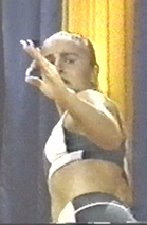
Aside from clothing, there is also the issue of grooming. All of the martial arts schools in which I have trained have had rules concerning grooming, specifically stating that the length of toe and finger nails should be kept short. There are several reasons for this. The first and foremost is safety. If two students are working together on self-defense or sparring there is a possibility that long nails can cause injury. A second reason for keeping finger nails short is to allow the student to make a proper fist. The woman in the picture below has finger nails so long that it would be impossible for her to punch with proper technique since it would be impossible for her to make a proper fist. This clearly shows that her goal is not to execute proper technique.
Balance
One of the most important physical qualities that a martial artist strives to develop is balance while kicking. Balance is required for proper and controlled technique. Without balance, kicks seem flailing and awkward. Balance is developed by practicing kicks slowly and concentrating on the position of every part of the body throughout the entire kick. Having proper balance means that a proper defensive guard can be kept while kicking, otherwise the arms and hands must be used to maintain balance instead of fend off attack.
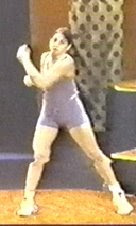
If the point of the movement is merely exercise, then proper and controlled technique is not a concern. However, being able to “kick” is more than just the ability to throw your foot into the air. Radio City Music Hall’s Rockettes “kick,” but certainly not in the martial artist’s sense of the word. The women in the picture below clearly are not worried about their balance since they are leaning on the support leg with their back hand (something Billy Blanks does, too). This practice means that proper balance is not achieved and effective technique is not the goal.

Focus and Concentration
Focus and concentration are essential to effective martial arts practice. The ability to pick a target and execute a technique to strike that target is essential for a self-defense situation. The woman in the bottom left of the picture below is clearly not focusing on a target; she is just thrusting her foot behind her without any understanding of the technique or application of the technique. A proper back kick must include a turning of the head to put the target in sight. By allowing students to perform techniques this poorly, Billy Blanks is allowing them to develop bad habits that will be difficult to overcome in a traditional martial arts environment.

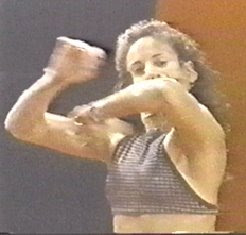
“Tae-Bo”, which I’ve read is an acronym that combines Taekwondo (the way of striking with the hands and feet) with boxing, also utilizes many hand techniques that are common to martial arts and boxing, which is not a martial art due to its pugilistic nature. One of these techniques is the upper-cut punch. The woman in the picture below is performing an upper-cut. Clearly, she is not concentrating on what she is doing and is not focused on her target or her head would be turned in the direction of her fist. Furthermore, since the power in an upper-cut, like most martial arts techniques, comes from the hips; she is clearly not executing the technique with any significant degree of power. In order to properly execute a left upper-cut, she would have to twist her hips and pivot on her left foot and use her leg and hip strength to supply the power; as opposed to her arm. She would also need to keep her hand closer to her body since an upper-cut is an “inside” technique, meaning it is used only when one is close to their opponent.
A practice often engaged in by boxers and sometimes martial artists is the use of a speed bag. The purpose of a speed bag, as I understand it, is to help the user develop concentration, focus, and stamina. I have used a speed bag in my muay Thai training and it certainly requires concentration and focus. One wrong hit will result in chaos. As for stamina, I could never keep it going long enough to test my stamina since proficiency requires a lot of practice. The picture below is of a woman engaged in Tae-Bo’s “speed bag” exercise. Apart from the fact that she is not even making a proper fist, is that she is clearly not concentrating and is obviously not focused on what she is doing. Using a speed bag is much more than just rolling your arms to music like a 70’s disco dancer, but Billy Blanks doesn’t make that clear.
Self-Defense
Probably the most disturbing aspect of the cardio-karate fad is that many of the participants are falsely led to believe that they are learning self-defense. “In his infomercials, some of Blank’s female students claim that their [Tae-Bo] training makes them feel safer on the street. That’s misleading. Tae-Bo students are only throwing punches and kicks to music; they are not learning self-defense. They have no idea what the techniques are for.” (Wallace, 1999) On his Advanced Tae-Bo Workout tape, Billy Blanks states before one particular exercise, “focus on somebody grabbing you, and you have to protect yourself.” This type of focus, is not something that can easily be visualized. Learning self-defense requires four things: a patient and knowledgeable instructor, practice, practice, and more practice. Effective self-defense is learned with a partner and an instructor over a long period of time. It is not something that can be “picked up” from a video or during a fast-paced cardiovascular workout.
Clearly there could be disastrous results if one is falsely led to believe they have the ability to defend themselves. One of the easiest ways to prevent yourself from getting hurt is to avoid possible confrontations in the first place. Many martial arts instructors, especially in regards to women, are very adamant about this issue. However, people who confident in their ability are more likely to allow themselves to be in a situation in which they might need to use it. If this confidence is not supported by knowledge and experience then it could lead to people getting seriously hurt, or worse, when they get engaged in a confrontation and are unable to successfully defend themselves.
Proper Technique
The fast-paced nature of cardio-karate does not allow the instructor to take the time to demonstrate proper technique and correct improper technique. This problem is the primary reason that these programs do not prepare students for regular martial arts classes. “Students should be taught how to do the techniques correctly. For example, throwing a kick out and just letting the leg drop instead of snapping it back is bad for the joints, cartilage and ligaments. Blanks should take a few minutes before the workout to show his students how to properly execute the hand and foot techniques. It is very possible that the students would enjoy learning the meaning behind the kicks and punches they’re throwing.” (Wallace, 1999) However, this is not enough if the students still perform then incorrectly even after being shown. Just demonstrating or explaining a technique is oftentimes not enough for students who may need the physical contact of kinesthetic instruction.
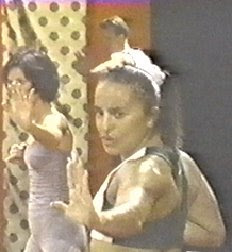
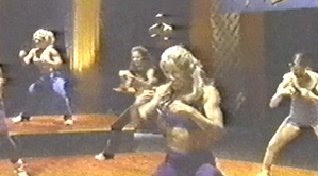
Aside from the physical danger of executing techniques improperly is the practical danger of allowing them to be practiced improperly. The women in the picture below are clearly not executing proper open-hand blocking technique. The woman in the front has her wrist bent, her arm nearly straight and her thumb sticking out. In addition to that, the woman in the back clearly does not have her fingers tight enough to prevent injury or her back hand in a proper fist. The reason that it is necessary to keep one’s fingers tight, or hand in a proper fist, is that the strength in the hand, or fist, is greater than the sum of its parts. A blow that may break one finger would probably not break all five, and a proper fist can strike with a much greater force than could normally be withstood by a single bone. Locking out one’s arm is a recipe for elbow and shoulder injury, and bending the wrist takes away the support that the arm provides when keeping it straight.
The picture below is during “double-time punches” and it is clear that speed and not proper technique is the goal of the exercise. Experienced and effective martial arts instructors always stress that proper technique, not speed, is of primary concern even when speed is a secondary goal. Since the power from punches mostly comes from twisting the hips and abdominal muscles, not just the arms, these “flurry” punches are anything but effective technique.
Again, these practices are likely to cause bad habits to be developed. Bad habits that would be difficult to break if serious budo training were to begin. Students who would like to train to be faster must first train to do the technique correctly. Improper technique is doomed to be ineffective regardless of speed.
Recommendations
“Blanks should take a few minutes before the workout to show his students how to properly execute the hand and foot techniques. It is very possible that the students would enjoy learning the meaning behind the kicks and punches they’re throwing.” (Wallace, 1999) Those who are interested would be more likely to enroll in regular martial arts classes when they experience the techniques for what they really are. These few minutes of instruction on a video could easily be skipped by people who have already had it, and in live classes those who do not need the extra help could just plan on starting a bit later. In the Tae-Bo videos, it would definitely be a better example if the participants were chosen based on the ability to properly execute the techniques and not just how they look in a leotard.
Joe Lewis’s Kickbox Fitness system include resistance training, which provides a more realistic experience. Just punching or kicking into the air does not give the participant any indication as to whether their technique is effective. Without any resistance, poor technique and perfect technique can look and feel very much the same. The use of resistance training can help the instructor evaluate the students’ technique in order to improve it. Clearly, the use of heavy and speed bags, pads, and gloves would not be practical all the time, due to space constraints and cost of equipment; but enough of it to help the student understand the difference between effective and ineffective technique would better prepare the student for actual martial arts training.
Conclusion
Cardio-karate can provide a valuable workout for those who desire just that. As for a stepping stone to martial arts training, it can be a step in the wrong direction. As a martial artist with enough experience to be able to properly execute the techniques, most of the time, I was able to get an excellent workout using Advanced Tae-Bo. I have also taken several cardio-karate classes and, apart from the annoying music, found them to be quite helpful. As a result, I would highly recommend these types of programs to accomplished martial artists who are already confident in their technique and are looking for an additional cardiovascular workout. However, our of fear of forming habitually bad technique, I do not recommend them to beginners or as feeder programs for traditional martial arts schools.
The biggest and only danger with these types of programs is that the participants are often led to believe that what they are doing is a martial art when it is not. Martial arts training must have intellectual and spiritual components that transcend the physical. In learning, studying, and practicing kata (forms), bunkai (interpretation), and self-defense, karateka (practitioners) also learn about themselves. It is the whole package that is necessary to constitute a martial art, anything less is merely exercise, or street fighting.
Bibliography
“Billy Blanks’ Tae-Bo: Advanced Tae-Bo.” Videotape. Billy Blanks. 1998.
Lewis, Joe. “Fighting or Fitness?” Black Belt. August, 1999, p. 24.
Lowry, Dave. “Dressing the Part.” Black Belt. August, 1999, p. 22.
Wallace, Bill. “Pros and Cons of Tae-Bo Aerobics” Black Belt. August, 1999, p. 30.
O’Shea, Michael. “Get Fit While You Get Your Kicks” Parade. July 25, 1999. On the Internet at http://www.kickboxfitness.com/Parade.htm.
The purpose of cardio-karate and similar programs is to provide participants with a cardiovascular workout and, supposedly, with an understanding of the basic techniques of martial arts. What these programs fail to do is provide adequate instruction on the details of the basics, thereby allowing the students to develop habitually poor martial arts technique.
Introduction
Cardio-karate has become big business, filling up gyms and taking over aerobics classes all over the country. Many people, bored with the usual workout routines, have turned to it as a way to cure their boredom and, they think, learn a bit about self-defense. Many karate and other martial arts schools have jumped on the bandwagon as well. These types of classes can supplement their student-base, take up floor time that might have otherwise been wasted, and serve as a “feeder” program to their regular, more lucrative, and longer-term martial arts programs.
One problem with this sort of arrangement is that many cardio-karate students are only in it for the exercise and don’t have any interest in the martial arts. Another problem is that students who begin taking the regular martial arts classes might be disappointed if the intensity of the class doesn’t keep pace with that of their cardiovascular workout. However, the most long-term problem is the likelihood that a student who learned to punch and kick while watching a video or taking a cardio-karate class didn’t learn how to punch or kick properly. By spending months, or sometimes years, practicing improper technique, the new martial arts student has developed bad habits that will either never get broken or will take a great deal of extra effort on the part of the student and the instructor.
This paper will focus on specific bad habits and practices that can be observed on Billy Blanks’ Advanced Tae-Bo Workout tape. The reasons this particular tape was chosen are two-fold. First, Tae-Bo has become very popular and is likely to be representative of the entire genre. Second, I have a copy of the tape and have been able to analyze it in depth. The following sections, followed by a conclusion, will compare different facets of martial arts training with the Tae-Bo workout, to support the premise of this paper as stated in the abstract.
This is not an argument against Tae-Bo or any other aerobic exercise. On the contrary, Tae-Bo is an excellent workout and I would recommend it to anyone who is interested in increasing their stamina, strength, and endurance. The focus of this paper is to clarify what Tae-Bo is NOT. Tae-Bo is NOT martial arts training and when beginning students treat it as if it were then they are practicing bad habits that can be difficult to break if they do begin martial arts training.
Appearance
Enter any traditional martial arts dojo (training hall) and you will immediately notice that all of the students are wearing basically the same training uniform, a keikogi (euphemistically shortened to just “gi”). “The wearing of a keikogi is a physical way of establishing that this activity is not like any other. It’s true that beginners look awkward in a new keikogi, [but] they’d look nearly the same no matter what they wore because when they try the basic movements of an unfamiliar art they will always appear awkward. Part of any serious budo (warrior way) training is coming face-to-face with this awkwardness, acknowledging it and attempting to over come it.” (Lowry, 1999) By wearing Spandex and sneakers, and allowing the students to do the same, Billy Blanks is clearly not taking part in any serious budo training. He’s just working out.
Aside from clothing, there is also the issue of grooming. All of the martial arts schools in which I have trained have had rules concerning grooming, specifically stating that the length of toe and finger nails should be kept short. There are several reasons for this. The first and foremost is safety. If two students are working together on self-defense or sparring there is a possibility that long nails can cause injury. A second reason for keeping finger nails short is to allow the student to make a proper fist. The woman in the picture below has finger nails so long that it would be impossible for her to punch with proper technique since it would be impossible for her to make a proper fist. This clearly shows that her goal is not to execute proper technique.

Balance
One of the most important physical qualities that a martial artist strives to develop is balance while kicking. Balance is required for proper and controlled technique. Without balance, kicks seem flailing and awkward. Balance is developed by practicing kicks slowly and concentrating on the position of every part of the body throughout the entire kick. Having proper balance means that a proper defensive guard can be kept while kicking, otherwise the arms and hands must be used to maintain balance instead of fend off attack.
If the point of the movement is merely exercise, then proper and controlled technique is not a concern. However, being able to “kick” is more than just the ability to throw your foot into the air. Radio City Music Hall’s Rockettes “kick,” but certainly not in the martial artist’s sense of the word. The women in the picture below clearly are not worried about their balance since they are leaning on the support leg with their back hand (something Billy Blanks does, too). This practice means that proper balance is not achieved and effective technique is not the goal.

Focus and Concentration
Focus and concentration are essential to effective martial arts practice. The ability to pick a target and execute a technique to strike that target is essential for a self-defense situation. The woman in the bottom left of the picture below is clearly not focusing on a target; she is just thrusting her foot behind her without any understanding of the technique or application of the technique. A proper back kick must include a turning of the head to put the target in sight. By allowing students to perform techniques this poorly, Billy Blanks is allowing them to develop bad habits that will be difficult to overcome in a traditional martial arts environment.

“Tae-Bo”, which I’ve read is an acronym that combines Taekwondo (the way of striking with the hands and feet) with boxing, also utilizes many hand techniques that are common to martial arts and boxing, which is not a martial art due to its pugilistic nature. One of these techniques is the upper-cut punch. The woman in the picture below is performing an upper-cut. Clearly, she is not concentrating on what she is doing and is not focused on her target or her head would be turned in the direction of her fist. Furthermore, since the power in an upper-cut, like most martial arts techniques, comes from the hips; she is clearly not executing the technique with any significant degree of power. In order to properly execute a left upper-cut, she would have to twist her hips and pivot on her left foot and use her leg and hip strength to supply the power; as opposed to her arm. She would also need to keep her hand closer to her body since an upper-cut is an “inside” technique, meaning it is used only when one is close to their opponent.

A practice often engaged in by boxers and sometimes martial artists is the use of a speed bag. The purpose of a speed bag, as I understand it, is to help the user develop concentration, focus, and stamina. I have used a speed bag in my muay Thai training and it certainly requires concentration and focus. One wrong hit will result in chaos. As for stamina, I could never keep it going long enough to test my stamina since proficiency requires a lot of practice. The picture below is of a woman engaged in Tae-Bo’s “speed bag” exercise. Apart from the fact that she is not even making a proper fist, is that she is clearly not concentrating and is obviously not focused on what she is doing. Using a speed bag is much more than just rolling your arms to music like a 70’s disco dancer, but Billy Blanks doesn’t make that clear.

Self-Defense
Probably the most disturbing aspect of the cardio-karate fad is that many of the participants are falsely led to believe that they are learning self-defense. “In his infomercials, some of Blank’s female students claim that their [Tae-Bo] training makes them feel safer on the street. That’s misleading. Tae-Bo students are only throwing punches and kicks to music; they are not learning self-defense. They have no idea what the techniques are for.” (Wallace, 1999) On his Advanced Tae-Bo Workout tape, Billy Blanks states before one particular exercise, “focus on somebody grabbing you, and you have to protect yourself.” This type of focus, is not something that can easily be visualized. Learning self-defense requires four things: a patient and knowledgeable instructor, practice, practice, and more practice. Effective self-defense is learned with a partner and an instructor over a long period of time. It is not something that can be “picked up” from a video or during a fast-paced cardiovascular workout.
Clearly there could be disastrous results if one is falsely led to believe they have the ability to defend themselves. One of the easiest ways to prevent yourself from getting hurt is to avoid possible confrontations in the first place. Many martial arts instructors, especially in regards to women, are very adamant about this issue. However, people who confident in their ability are more likely to allow themselves to be in a situation in which they might need to use it. If this confidence is not supported by knowledge and experience then it could lead to people getting seriously hurt, or worse, when they get engaged in a confrontation and are unable to successfully defend themselves.
Proper Technique
The fast-paced nature of cardio-karate does not allow the instructor to take the time to demonstrate proper technique and correct improper technique. This problem is the primary reason that these programs do not prepare students for regular martial arts classes. “Students should be taught how to do the techniques correctly. For example, throwing a kick out and just letting the leg drop instead of snapping it back is bad for the joints, cartilage and ligaments. Blanks should take a few minutes before the workout to show his students how to properly execute the hand and foot techniques. It is very possible that the students would enjoy learning the meaning behind the kicks and punches they’re throwing.” (Wallace, 1999) However, this is not enough if the students still perform then incorrectly even after being shown. Just demonstrating or explaining a technique is oftentimes not enough for students who may need the physical contact of kinesthetic instruction.
Aside from the physical danger of executing techniques improperly is the practical danger of allowing them to be practiced improperly. The women in the picture below are clearly not executing proper open-hand blocking technique. The woman in the front has her wrist bent, her arm nearly straight and her thumb sticking out. In addition to that, the woman in the back clearly does not have her fingers tight enough to prevent injury or her back hand in a proper fist. The reason that it is necessary to keep one’s fingers tight, or hand in a proper fist, is that the strength in the hand, or fist, is greater than the sum of its parts. A blow that may break one finger would probably not break all five, and a proper fist can strike with a much greater force than could normally be withstood by a single bone. Locking out one’s arm is a recipe for elbow and shoulder injury, and bending the wrist takes away the support that the arm provides when keeping it straight.

The picture below is during “double-time punches” and it is clear that speed and not proper technique is the goal of the exercise. Experienced and effective martial arts instructors always stress that proper technique, not speed, is of primary concern even when speed is a secondary goal. Since the power from punches mostly comes from twisting the hips and abdominal muscles, not just the arms, these “flurry” punches are anything but effective technique.
Again, these practices are likely to cause bad habits to be developed. Bad habits that would be difficult to break if serious budo training were to begin. Students who would like to train to be faster must first train to do the technique correctly. Improper technique is doomed to be ineffective regardless of speed.

Recommendations
“Blanks should take a few minutes before the workout to show his students how to properly execute the hand and foot techniques. It is very possible that the students would enjoy learning the meaning behind the kicks and punches they’re throwing.” (Wallace, 1999) Those who are interested would be more likely to enroll in regular martial arts classes when they experience the techniques for what they really are. These few minutes of instruction on a video could easily be skipped by people who have already had it, and in live classes those who do not need the extra help could just plan on starting a bit later. In the Tae-Bo videos, it would definitely be a better example if the participants were chosen based on the ability to properly execute the techniques and not just how they look in a leotard.
Joe Lewis’s Kickbox Fitness system include resistance training, which provides a more realistic experience. Just punching or kicking into the air does not give the participant any indication as to whether their technique is effective. Without any resistance, poor technique and perfect technique can look and feel very much the same. The use of resistance training can help the instructor evaluate the students’ technique in order to improve it. Clearly, the use of heavy and speed bags, pads, and gloves would not be practical all the time, due to space constraints and cost of equipment; but enough of it to help the student understand the difference between effective and ineffective technique would better prepare the student for actual martial arts training.
Conclusion
Cardio-karate can provide a valuable workout for those who desire just that. As for a stepping stone to martial arts training, it can be a step in the wrong direction. As a martial artist with enough experience to be able to properly execute the techniques, most of the time, I was able to get an excellent workout using Advanced Tae-Bo. I have also taken several cardio-karate classes and, apart from the annoying music, found them to be quite helpful. As a result, I would highly recommend these types of programs to accomplished martial artists who are already confident in their technique and are looking for an additional cardiovascular workout. However, our of fear of forming habitually bad technique, I do not recommend them to beginners or as feeder programs for traditional martial arts schools.
The biggest and only danger with these types of programs is that the participants are often led to believe that what they are doing is a martial art when it is not. Martial arts training must have intellectual and spiritual components that transcend the physical. In learning, studying, and practicing kata (forms), bunkai (interpretation), and self-defense, karateka (practitioners) also learn about themselves. It is the whole package that is necessary to constitute a martial art, anything less is merely exercise, or street fighting.
Bibliography
Wednesday, April 29, 2009
Audience Involvement
Hi!
It had been a while since I posted to my presentation skills blog, so it's a good thing I was inspired today. My post on audience involvement explains why and how to connect with your audience.
Thanks,
Matt
It had been a while since I posted to my presentation skills blog, so it's a good thing I was inspired today. My post on audience involvement explains why and how to connect with your audience.
Thanks,
Matt
Audience Involvement
Hi!
My last post was based on an evaluation I had just done and this one is no different. The speaker gave a well-researched talk on the advantages of Internet TV over Cable TV; the problem is that the audience wasn't a part of it.
In my "Parts of Speech" post in January, I recommended starting a speech with something that will draw the audience in. In the case of this topic, I'd recommend starting with a question: "Who would like to save $50 per month?" The key to an opening question is to ask one to which everyone in the audience will have the same (preferably affirmative) answer. Who wouldn't want to listen after an opening like that?
It doesn't end there, though! Keep asking questions!! They are also a great way to transition from one main point to another. For example, "Who has a high-speed Internet connection?" could be a great transition into a discussion on what's available on-line. In this audience, everyone did, but if you're not sure then you could phrase it differently.
Effective audience involvement will not only help you make a connection with your audience, but can help you keep it. It's the connection that makes a speaker more influential and persuasive, so strive to make it work.
Thanks,
Matt
My last post was based on an evaluation I had just done and this one is no different. The speaker gave a well-researched talk on the advantages of Internet TV over Cable TV; the problem is that the audience wasn't a part of it.
In my "Parts of Speech" post in January, I recommended starting a speech with something that will draw the audience in. In the case of this topic, I'd recommend starting with a question: "Who would like to save $50 per month?" The key to an opening question is to ask one to which everyone in the audience will have the same (preferably affirmative) answer. Who wouldn't want to listen after an opening like that?
It doesn't end there, though! Keep asking questions!! They are also a great way to transition from one main point to another. For example, "Who has a high-speed Internet connection?" could be a great transition into a discussion on what's available on-line. In this audience, everyone did, but if you're not sure then you could phrase it differently.
Effective audience involvement will not only help you make a connection with your audience, but can help you keep it. It's the connection that makes a speaker more influential and persuasive, so strive to make it work.
Thanks,
Matt
Tuesday, April 28, 2009
How to Effectively Use Social Networking
Hi!
This is more of an open letter than a guide, as I really don't know. I started blogging and using LinkedIn a while ago, but am new to Facebook and Twitter. They both seem like useful tools, so what's my problem? My problem is this: How can I use these tools without them turning into something that controls me rather than the other way around? To really be "social" on these sites, one must be on them often. My goal is to be "social" to I'm struggling to find the balance.
(Disclosure: I recently completed a CareerLeader assessment as part of the Career Management Seminar at Thunderbird. I earned very high interpersonal effectiveness scores in Ability to Teach, Assertiveness, Comfort with Differences, Empathy Skills, Influence, Oral Communication, Respect for Others, and Sensitivity and Tact. I earned a low score in Sociability.)
These days, sociability often means using social networking sites effectively. It's MUCH easier to maintain relationships on-line than it is in person. This is especially true when those with whom we want to maintain relationships are geographically dispersed. The key is "effectively." If I have to use several different sites to do this, I'm not being very effective.
I recently found a way to update my Twitter and Facebook status at the same time using a Facebook app. This helps, but it forces my Facebook update to have the same character limitations as a Twitter update. What about my blog posts? What'd be really, REALLY cool is a nice front end for all these sites. I write a blog post and can automatically add a link to it to Facebook and Twitter. LinkedIn has a "What are you working on now?" option in the main page. Why not link this with Twitter and/or Facebook...or at least provide the option?
I'm sure these tools will evolve and some day we'll look back on having to do multiple updates with the same feelings we get about having to get up change the channel on the TV. For now, though, I'll have to accept some measure of inefficiency in order to improve my on-line sociability...
Thanks,
Matt
This is more of an open letter than a guide, as I really don't know. I started blogging and using LinkedIn a while ago, but am new to Facebook and Twitter. They both seem like useful tools, so what's my problem? My problem is this: How can I use these tools without them turning into something that controls me rather than the other way around? To really be "social" on these sites, one must be on them often. My goal is to be "social" to I'm struggling to find the balance.
(Disclosure: I recently completed a CareerLeader assessment as part of the Career Management Seminar at Thunderbird. I earned very high interpersonal effectiveness scores in Ability to Teach, Assertiveness, Comfort with Differences, Empathy Skills, Influence, Oral Communication, Respect for Others, and Sensitivity and Tact. I earned a low score in Sociability.)
These days, sociability often means using social networking sites effectively. It's MUCH easier to maintain relationships on-line than it is in person. This is especially true when those with whom we want to maintain relationships are geographically dispersed. The key is "effectively." If I have to use several different sites to do this, I'm not being very effective.
I recently found a way to update my Twitter and Facebook status at the same time using a Facebook app. This helps, but it forces my Facebook update to have the same character limitations as a Twitter update. What about my blog posts? What'd be really, REALLY cool is a nice front end for all these sites. I write a blog post and can automatically add a link to it to Facebook and Twitter. LinkedIn has a "What are you working on now?" option in the main page. Why not link this with Twitter and/or Facebook...or at least provide the option?
I'm sure these tools will evolve and some day we'll look back on having to do multiple updates with the same feelings we get about having to get up change the channel on the TV. For now, though, I'll have to accept some measure of inefficiency in order to improve my on-line sociability...
Thanks,
Matt
Monday, April 27, 2009
Arizona OKKK Lineage
Hi!
I found the files from a web site Ms. Rush and I created long ago and thought I'd start sharing it on the blog. Here's a post on our OKKK lineage.
Thanks,
Matt
I found the files from a web site Ms. Rush and I created long ago and thought I'd start sharing it on the blog. Here's a post on our OKKK lineage.
Thanks,
Matt
Arizona OKKK Lineage
Hi!
I found the files from a web site Ms. Rush and I created long ago and thought I'd start sharing it on the blog. Here's our lineage:
Master Shigeru Nakamura

Master Nakamura was born in 1894 and lived in the City of Nago. His first introduction to karate came at the Icchu Middle School, in Shuri where Karate had just been introduced to the educational system. His instructors included Kanryo Higashionna, Kentsu Yabu & Chomo Hanashiro. Yastune Itosu also made periodic visits to the school. Upon graduation from the middle school, Nakamura returned to Nago, where he continued his training under Shinkichi Kunioshi, the successor to the legendary Naha "Bushi" Sakiyama. In 1953 Nakamura established his own dojo in Nago City, calling his form of the art "Okinawa Kenpo".
In 1955, the "Okinawa Kenpo Renmei" was formed by Masters Shigeru Nakamura and Zenryo Shimabuku, with Master Nakamura as President. Master Nakamura was known for his development of the "Bogu Gear" for contact sparring.
Master Seikichi Odo
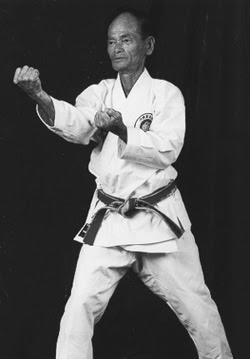
After Master Nakamura's death in 1969, the Okinawa Kenpo Renmei, appointed SEIKICHI ODO as Master of Okinawa Kenpo Karate. As Master of Okinawa Kenpo, Seikichi Odo was also installed as President of the All Okinawa Kenpo Karate-do League. Shortly afterwards, Master Odo officially added the weapons to the Okinawa Kenpo system, with the result being what we now know as "Okinawa Kenpo Karate-Kobudo".
In the mid-1970's Master Odo created the "Okinawa Kenpo Karate Kobudo Association", to be renamed in 1983 to the "Okinawa Kenpo Karate-Kobudo Federation". Today Master Odo is ranked as Judan (10th Dan) in both Karate and Kobudo, and is considered one of the top weapons practitioners in the world today. In 1998, Master Odo renamed the Okinawa Kenpo Karate-Kobudo Federation to be the "Ryukyu Hon Kenpo Kobujutsu Federation", and changed the name of the arts taught under his direct auspices to "Ryukyu Hon Kenpo Kobujutsu".
Shihan Larry Isaac

For over 25 years, Shihan Isaac's experience, expertise, and positive teaching/training methods have literally dominated the martial arts tournament circuit, both regionally and nationally. Shihan Isaac is the first and only martial arts instructor from the Carolinas to be a National Triple Crown winner. In fact, he is a six-time national champion who has been rated in all of the major karate circuits.
Nationally, Shihan Isaac has been ranked No. 1 in Kata (Forms), ranked No. 1 in Weapons, and ranked No. 2 in Fighting in the Senior Divisions. In 1990 and 1991, he was inducted in the Professional Karate League's (PKL) Hall of Fame. In 1989, after winning the International Association of Martial Artists (IAMA) International Karate Championships in Edison, New Jersey, Shihan Isaac was inducted into the IAMA organization by Master Gary Alexander (10th Dan). Shihan Isaac is an active member of the International Okinawa Kenpo-Kobudo Karate Council under Grandmaster Seikichi Odo (10th Dan).
Renshi Robyn Rush-James
Ms. Rush's story will have to be another post. In the meantime, please enjoy this one and stay tuned for more.
Thanks,
Matt
I found the files from a web site Ms. Rush and I created long ago and thought I'd start sharing it on the blog. Here's our lineage:
Master Shigeru Nakamura

Master Nakamura was born in 1894 and lived in the City of Nago. His first introduction to karate came at the Icchu Middle School, in Shuri where Karate had just been introduced to the educational system. His instructors included Kanryo Higashionna, Kentsu Yabu & Chomo Hanashiro. Yastune Itosu also made periodic visits to the school. Upon graduation from the middle school, Nakamura returned to Nago, where he continued his training under Shinkichi Kunioshi, the successor to the legendary Naha "Bushi" Sakiyama. In 1953 Nakamura established his own dojo in Nago City, calling his form of the art "Okinawa Kenpo".
In 1955, the "Okinawa Kenpo Renmei" was formed by Masters Shigeru Nakamura and Zenryo Shimabuku, with Master Nakamura as President. Master Nakamura was known for his development of the "Bogu Gear" for contact sparring.
Master Seikichi Odo

After Master Nakamura's death in 1969, the Okinawa Kenpo Renmei, appointed SEIKICHI ODO as Master of Okinawa Kenpo Karate. As Master of Okinawa Kenpo, Seikichi Odo was also installed as President of the All Okinawa Kenpo Karate-do League. Shortly afterwards, Master Odo officially added the weapons to the Okinawa Kenpo system, with the result being what we now know as "Okinawa Kenpo Karate-Kobudo".
In the mid-1970's Master Odo created the "Okinawa Kenpo Karate Kobudo Association", to be renamed in 1983 to the "Okinawa Kenpo Karate-Kobudo Federation". Today Master Odo is ranked as Judan (10th Dan) in both Karate and Kobudo, and is considered one of the top weapons practitioners in the world today. In 1998, Master Odo renamed the Okinawa Kenpo Karate-Kobudo Federation to be the "Ryukyu Hon Kenpo Kobujutsu Federation", and changed the name of the arts taught under his direct auspices to "Ryukyu Hon Kenpo Kobujutsu".
Shihan Larry Isaac

For over 25 years, Shihan Isaac's experience, expertise, and positive teaching/training methods have literally dominated the martial arts tournament circuit, both regionally and nationally. Shihan Isaac is the first and only martial arts instructor from the Carolinas to be a National Triple Crown winner. In fact, he is a six-time national champion who has been rated in all of the major karate circuits.
Nationally, Shihan Isaac has been ranked No. 1 in Kata (Forms), ranked No. 1 in Weapons, and ranked No. 2 in Fighting in the Senior Divisions. In 1990 and 1991, he was inducted in the Professional Karate League's (PKL) Hall of Fame. In 1989, after winning the International Association of Martial Artists (IAMA) International Karate Championships in Edison, New Jersey, Shihan Isaac was inducted into the IAMA organization by Master Gary Alexander (10th Dan). Shihan Isaac is an active member of the International Okinawa Kenpo-Kobudo Karate Council under Grandmaster Seikichi Odo (10th Dan).
Renshi Robyn Rush-James
Ms. Rush's story will have to be another post. In the meantime, please enjoy this one and stay tuned for more.
Thanks,
Matt
Sunday, April 26, 2009
Spike
Hi!
I wrote about the roaches and I wrote about the dogs. Here's a post on the snake, Spike. Spike is an albino corn snake and was Joshua's Christmas present in 2007. Corn snakes are harmless and are pretty cool pets. Here's a picture of spike starting on his weekly meal:
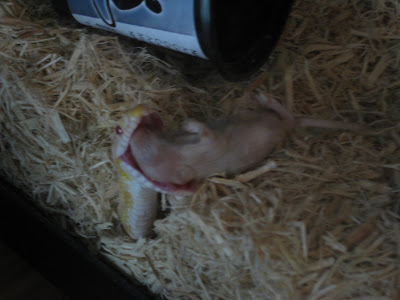
When we first got him, he ate three pinkies per week. Now he's up to three fuzzies. If you click on the "pinkies" link, you'll see what they look like and can easily imagine what a "fuzzie" would look like...
Why a corn snake? Did I mention they're harmless? As a kind of constrictor, they can be very cuddly (for a reptile) and it feels really...interesting. The strength along every centimeter of his body is obvious. One of the Kindergarten class pets at Desert Sun is Corndog, who is also a corn snake. Corndog is full grown and spent several long weekends and vacations at our house, so we knew what to expect. Here's a picture of me and Joshua with Corndog:

More pictures can be found on our SmugMug site. Snakes are really low-maintenance pets. They need to be fed and watered about once per week and can be held any time (as long as they haven't just eaten). In this regard, I consider Spike to be a "real" pet...
Thanks,
Matt
I wrote about the roaches and I wrote about the dogs. Here's a post on the snake, Spike. Spike is an albino corn snake and was Joshua's Christmas present in 2007. Corn snakes are harmless and are pretty cool pets. Here's a picture of spike starting on his weekly meal:

When we first got him, he ate three pinkies per week. Now he's up to three fuzzies. If you click on the "pinkies" link, you'll see what they look like and can easily imagine what a "fuzzie" would look like...
Why a corn snake? Did I mention they're harmless? As a kind of constrictor, they can be very cuddly (for a reptile) and it feels really...interesting. The strength along every centimeter of his body is obvious. One of the Kindergarten class pets at Desert Sun is Corndog, who is also a corn snake. Corndog is full grown and spent several long weekends and vacations at our house, so we knew what to expect. Here's a picture of me and Joshua with Corndog:

More pictures can be found on our SmugMug site. Snakes are really low-maintenance pets. They need to be fed and watered about once per week and can be held any time (as long as they haven't just eaten). In this regard, I consider Spike to be a "real" pet...
Thanks,
Matt
Thursday, April 23, 2009
Why I Keep Training
Hi!
This week, Brandi was diagnosed with a broken bone in her left ankle. It had been bothering her for a while and it was an injury to her left foot that thwarted her third degree test a couple of years ago. (She'll say now that she wishes she had tested in spite of the pain, because we had no reason to believe it'd take her out for so long.) Brandi's wearing a boot and is supposed to be on crutches. We don't really know what'll happen.
I went with Joshua to class on Monday. It was the first time he'd been to class in about a month. Jacqueline hasn't been in a while. We decided when we started that we wouldn't force the kids to go. We'd rather them think of martial arts training as a part of their lives, as opposed to an "activity" that they "do" before replacing it with another "activity" that they "do." (This is in response to hearing parents say that their "kid does karate." I prefer to think of my kids as becoming martial artists.)
This is essentially why I keep training. I have become a martial artist. Even when I wasn't actively training (or "doing karate") due to injury, other commitments, or just plain frustration with not being able to find a suitable place, I still considered myself a martial artist. I train now because I've found a school I like, people I love to be with, and really enjoy it! Martial arts is a part of me. At the risk of using a cliche: It's not just what I do, it's who I am.
I'm usually at the Intel Ocotillo class on Thursday nights, but haven't been feeling well. Last week I attended a board meeting for Desert Sun instead, so it's been a few weeks. I miss it. I miss the workout and the people. I missed the weapons class at S&H Tuesday. It's been a tough week, but I've had tougher. What's great about these folks is that I know they miss me, too. We've got a good thing going and I'm sure that someday Brandi and the kids will be a bigger part of it, and that's why I keep training...
Take care!
Matt
This week, Brandi was diagnosed with a broken bone in her left ankle. It had been bothering her for a while and it was an injury to her left foot that thwarted her third degree test a couple of years ago. (She'll say now that she wishes she had tested in spite of the pain, because we had no reason to believe it'd take her out for so long.) Brandi's wearing a boot and is supposed to be on crutches. We don't really know what'll happen.
I went with Joshua to class on Monday. It was the first time he'd been to class in about a month. Jacqueline hasn't been in a while. We decided when we started that we wouldn't force the kids to go. We'd rather them think of martial arts training as a part of their lives, as opposed to an "activity" that they "do" before replacing it with another "activity" that they "do." (This is in response to hearing parents say that their "kid does karate." I prefer to think of my kids as becoming martial artists.)
This is essentially why I keep training. I have become a martial artist. Even when I wasn't actively training (or "doing karate") due to injury, other commitments, or just plain frustration with not being able to find a suitable place, I still considered myself a martial artist. I train now because I've found a school I like, people I love to be with, and really enjoy it! Martial arts is a part of me. At the risk of using a cliche: It's not just what I do, it's who I am.
I'm usually at the Intel Ocotillo class on Thursday nights, but haven't been feeling well. Last week I attended a board meeting for Desert Sun instead, so it's been a few weeks. I miss it. I miss the workout and the people. I missed the weapons class at S&H Tuesday. It's been a tough week, but I've had tougher. What's great about these folks is that I know they miss me, too. We've got a good thing going and I'm sure that someday Brandi and the kids will be a bigger part of it, and that's why I keep training...
Take care!
Matt
Wednesday, April 22, 2009
Equity for Debt Swap
Hi!
I heard on NPR's Planet Money that the government is asking some companies to convert the preferred stock it was given as a result of the bailout to common stock. What's the different? Preferred stock is non-voting stock (meaning its owners don't get to vote during shareholder meetings) and is treated like debt. This means that preferred stockholders will get paid first if the company goes under. Common stockholders may lose it all.
If the government becomes a common stockholder, and exercises the voting rights that come with it, we'll effectively have government control over these institutions. I've already written about this NOT being true nationalization, so I won't get into that here. What I'd like to suggest in this post is that the government make the swap, then offer the shares to tax-paying individuals...at a discount.
The reason I'm clear about it being "tax-paying individuals" is to prevent other institutions and governments from using this to take control of U.S. companies. People (in this case, tax-paying individuals) who want to buy shares (say, of Citibank) could do so at a reasonable discount from the market price (say, 5%). The incentive in the short term would be the discount.
The incentive in the long term would be a tax benefit. If the shares are sold within a year, then capital gains are taxed at a VERY high rate. This is to prevent people from buying at 5% and immediately selling for a ~5% gain. Lots of volume would drive prices down and be bad for everyone. If the shares are kept for more than 10 years, then the gains are not taxed at all.
What's in it for the government? Well, the government can get some cash back that can then be put to other use...like paying down the debt. Sitting on hundreds of billions of dollars of stock won't help, so why not sell it off in a way that can create value for the tax payers who funded it in the first place?
Thanks,
Matt
I heard on NPR's Planet Money that the government is asking some companies to convert the preferred stock it was given as a result of the bailout to common stock. What's the different? Preferred stock is non-voting stock (meaning its owners don't get to vote during shareholder meetings) and is treated like debt. This means that preferred stockholders will get paid first if the company goes under. Common stockholders may lose it all.
If the government becomes a common stockholder, and exercises the voting rights that come with it, we'll effectively have government control over these institutions. I've already written about this NOT being true nationalization, so I won't get into that here. What I'd like to suggest in this post is that the government make the swap, then offer the shares to tax-paying individuals...at a discount.
The reason I'm clear about it being "tax-paying individuals" is to prevent other institutions and governments from using this to take control of U.S. companies. People (in this case, tax-paying individuals) who want to buy shares (say, of Citibank) could do so at a reasonable discount from the market price (say, 5%). The incentive in the short term would be the discount.
The incentive in the long term would be a tax benefit. If the shares are sold within a year, then capital gains are taxed at a VERY high rate. This is to prevent people from buying at 5% and immediately selling for a ~5% gain. Lots of volume would drive prices down and be bad for everyone. If the shares are kept for more than 10 years, then the gains are not taxed at all.
What's in it for the government? Well, the government can get some cash back that can then be put to other use...like paying down the debt. Sitting on hundreds of billions of dollars of stock won't help, so why not sell it off in a way that can create value for the tax payers who funded it in the first place?
Thanks,
Matt
Saturday, April 18, 2009
Wall Street v. Washington
Hi!
I heard a story on NPR's Fresh Air warning of an impending showdown between Wall Street and Washington. The first battle is likely between Goldman Sachs and the White House. Goldman accepted $10B in TARP funds and wants to return it. Their reasoning is that they believe returning the money will free them from the restrictions the government has placed in recipients of TARP funds. Here's the rub:
What Goldman wants to do is use this (basically) as a recruiting and marketing tool. They want to be able to claim "Hey, we don't need TARP funds, so come invest with us since we're obviously stronger than our competitors...we're also unbound by compensation restrictions, so we can hire all the best talent!" This fails to acknowledge that it was this "talent" that got us into this mess in the first place, of course...
What makes the rub raw, though, is that Goldman received $13B from AIG as part of AIG's bailout. Will it be returning that money? Of course not! The claim that Goldman doesn't have any bailout money is not just misleading, it's a lie! The White House, of course, is not concerned just with Goldman, but the entire financial system. The showdown is whether Goldman will still be bound by the restrictions even if they give back the money. I think they should be.
Of course, Goldman's case is really a form of blackmail. They want to be ready to blame the government if things don't improve quickly. The White House needs to stand its ground. Giving in to Goldman will undermine the recovery efforts of other financial institutions in order to give Goldman a competitive advantage. In the future, any institution that is "too big to fail" should be prepared to be "too big to be independent" of additional government regulation.
Wall Street wants to own the upside while ensuring that the taxpayers own the downside. This isn't right and the White House needs to ensure that the system doesn't work this way in the future...
Thanks,
Matt
I heard a story on NPR's Fresh Air warning of an impending showdown between Wall Street and Washington. The first battle is likely between Goldman Sachs and the White House. Goldman accepted $10B in TARP funds and wants to return it. Their reasoning is that they believe returning the money will free them from the restrictions the government has placed in recipients of TARP funds. Here's the rub:
What Goldman wants to do is use this (basically) as a recruiting and marketing tool. They want to be able to claim "Hey, we don't need TARP funds, so come invest with us since we're obviously stronger than our competitors...we're also unbound by compensation restrictions, so we can hire all the best talent!" This fails to acknowledge that it was this "talent" that got us into this mess in the first place, of course...
What makes the rub raw, though, is that Goldman received $13B from AIG as part of AIG's bailout. Will it be returning that money? Of course not! The claim that Goldman doesn't have any bailout money is not just misleading, it's a lie! The White House, of course, is not concerned just with Goldman, but the entire financial system. The showdown is whether Goldman will still be bound by the restrictions even if they give back the money. I think they should be.
Of course, Goldman's case is really a form of blackmail. They want to be ready to blame the government if things don't improve quickly. The White House needs to stand its ground. Giving in to Goldman will undermine the recovery efforts of other financial institutions in order to give Goldman a competitive advantage. In the future, any institution that is "too big to fail" should be prepared to be "too big to be independent" of additional government regulation.
Wall Street wants to own the upside while ensuring that the taxpayers own the downside. This isn't right and the White House needs to ensure that the system doesn't work this way in the future...
Thanks,
Matt
Thursday, April 16, 2009
Chotoku Kyan no Sai Kata
Chotoku Kyan no Sai Kata is the first sai kata in the Okinawan weapons curriculum. A rough step-by-step description of the moves is below, though it is in no way a substitute for qualified instruction.
Ready position with sai closed in front
Step back right, horse stance, open low cross block
Shift into front stance, guard with left open, right closed
Step forward, RFF front stance, guard with right open, left closed
Step forward, LFF front stance, guard with left open, right closed
LH down block, back punch, front punch
Turn right, RFF front stance, RH cut down, close and rechamber
LF step forward, LFF front stance, LH cut down, close and rechamber
RF step forward, RFF front stance, RH cut down, close
RH down block, back punch, front punch
Turn left, LFF front stance, LH head block
RF step forward, RFF front stance, RH block out
RH cut down and in, RH cut down and out
RH down block, back punch, front punch
Shuffle forward, RH head block
LF step forward, LFF front stance, LH block out
LH cut down and in, LH cut down and out
LH down block, back punch, front punch
Shuffle forward, LH head block
RF step forward, RFF front stance, RH block out
RH cut down and in, RH cut down and out
RH down block, back punch, front punch
RF step across, LFF front stance, LH head block
RF step forward, RFF front stance, RH block out
RH cut down and in, RH cut down and out
RH down block, back punch, front punch
Shuffle forward, RH head block
LF step forward, LFF front stance, LH block out
LH cut down and in, LH cut down and out
LH down block, back punch, front punch
Shuffle forward, LH head block
RF step forward, RFF front stance, RH block out
RH cut down and in, RH cut down and out
RH down block, back punch, front punch
RF step back, feet together pointing west, hands left
RF step out, RFF long stance, RH throw low (simulated)
RF step back, LFF deep back stance, open guard
RF step forward, RFF front stance, RH uppercut stab, retract, close, down block
LF step forward, LFF front stance, LH uppercut stab, retract, close, down block
RF step forward, RFF front stance, RH uppercut stab, retract, close
RH down block, back punch, front punch
RF step back, horse stance, open low cross block
Flip out, close, double down block, LF step in, ready stance
Tuesday, April 14, 2009
Sunday, April 12, 2009
Practial Martial Arts
Hi!
I just published a post on my TKD blog on practical martial arts that I thought I'd share on this blog as well.
Enjoy!
Matt
I just published a post on my TKD blog on practical martial arts that I thought I'd share on this blog as well.
Enjoy!
Matt
Practical Martial Arts
Hi!
There's a lot of talk these days about making martial arts more "practical;" this is as opposed to "traditional." Most people define "practical" as "will help me win a street fight" as if those who practiced "traditional" martial arts in feudal Japan never had to worry about fighting... It's really quite ironic. Most martial arts schools cater to ordinary U.S. citizens, who live in one of the safest countries in one of the safest times. In this case, why is it "practical" for ordinary citizens to train as if street fights were a typical part of their day?
Maybe it's the fantasy that their martial arts training will turn them into the kind of bada$$ that they've always wanted to be. Most of us have jobs where any kind of fighting will get us fired, so what's the point? True self-defense isn't being the last one standing after every fight, it's not getting hurt. I wrote a post in January titled "Getting Hit On the Head Lessons" in which I question the wisdom of being beat up during training when the real goal of training is not to get beat up. Why, then, do we act as if martial arts is only "practical" if it covers really efficient ways of hurting others?
I know there are some jobs that actually require people to use martial arts training. I've trained with police officers who have stressed the "practicality" of their training. They didn't, however, focus on inflicting damage. They focused on control. It wasn't about hurting the other guy, it was about getting compliance WITHOUT hurting the other guy. Even the ex-military folks I know never talk about using their martial arts training in actual combat. They talk about training and "friendly fire" situation with fellow soldiers. Actual fighting, therefore, is VERY rare.
Here's what I consider "practical" martial arts training: Practical training is that which will help you in your daily life. For me, that's the discipline and self-control; that's flexibility and conditioning; that's practicing effective communication and teamwork. These are VERY practical skills in my world. These are skills that I developed through martial arts training and teaching, and these are skills that I try to help those I teach develop in themselves. This list may be different had I lived in feudal Japan, so I'm glad I live in the U.S.A. in 2009. I like the way I train and think it's VERY practical just the way it is...
Thanks,
Matt
There's a lot of talk these days about making martial arts more "practical;" this is as opposed to "traditional." Most people define "practical" as "will help me win a street fight" as if those who practiced "traditional" martial arts in feudal Japan never had to worry about fighting... It's really quite ironic. Most martial arts schools cater to ordinary U.S. citizens, who live in one of the safest countries in one of the safest times. In this case, why is it "practical" for ordinary citizens to train as if street fights were a typical part of their day?
Maybe it's the fantasy that their martial arts training will turn them into the kind of bada$$ that they've always wanted to be. Most of us have jobs where any kind of fighting will get us fired, so what's the point? True self-defense isn't being the last one standing after every fight, it's not getting hurt. I wrote a post in January titled "Getting Hit On the Head Lessons" in which I question the wisdom of being beat up during training when the real goal of training is not to get beat up. Why, then, do we act as if martial arts is only "practical" if it covers really efficient ways of hurting others?
I know there are some jobs that actually require people to use martial arts training. I've trained with police officers who have stressed the "practicality" of their training. They didn't, however, focus on inflicting damage. They focused on control. It wasn't about hurting the other guy, it was about getting compliance WITHOUT hurting the other guy. Even the ex-military folks I know never talk about using their martial arts training in actual combat. They talk about training and "friendly fire" situation with fellow soldiers. Actual fighting, therefore, is VERY rare.
Here's what I consider "practical" martial arts training: Practical training is that which will help you in your daily life. For me, that's the discipline and self-control; that's flexibility and conditioning; that's practicing effective communication and teamwork. These are VERY practical skills in my world. These are skills that I developed through martial arts training and teaching, and these are skills that I try to help those I teach develop in themselves. This list may be different had I lived in feudal Japan, so I'm glad I live in the U.S.A. in 2009. I like the way I train and think it's VERY practical just the way it is...
Thanks,
Matt
Friday, April 10, 2009
Why Lower Prices Are Bad
Hi!
I'm not referring to Wal-Mart here (though I could, but it'd be a different topic); I'm referring to deflation. Most people look at it from only their own perspective: Lower prices means I can buy more stuff!! This, however, assumes that you'll have the same amount of money. You might, at first, but it won't be long before you'll have less. Here's why, but we'll have to start thinking about it from the perspective of a venture capitalist.
Let's say you're being pitched an idea for a product that'll sell for $10. It's a really cool new product that you're sure everyone will want. At a $10 ASP (average selling price), you can expect to get your money back, and more, in just a couple of years. The problem is that after a period of deflation, the product can only sell for $5. At a lower ASP, you may NEVER get your money back, much less make any kind of return. What do you do? Well, you certainly wouldn't invest in any new products...
This is what would happen inside companies, too. They'd have a bunch of cash, but it'd be more valuable in the future if it just sat there rather than be invested in creating new products. This means that the company really can't grow. If the company (your company) can't grow, then it will probably start shrinking. Maybe you keep your job, or maybe you just get a pay cut. Now, things are cheaper, but your salary is smaller so your real purchasing power is what it was before, maybe less. It's a downward spiral.
The lesson here is that low prices that get that way due to improved efficiency are good; low prices that get that way due to a depressed economy are bad. A little inflation is a good thing as it encourages investment and development. Now you know why the government isn't trying to drive prices down...
Thanks,
Matt
I'm not referring to Wal-Mart here (though I could, but it'd be a different topic); I'm referring to deflation. Most people look at it from only their own perspective: Lower prices means I can buy more stuff!! This, however, assumes that you'll have the same amount of money. You might, at first, but it won't be long before you'll have less. Here's why, but we'll have to start thinking about it from the perspective of a venture capitalist.
Let's say you're being pitched an idea for a product that'll sell for $10. It's a really cool new product that you're sure everyone will want. At a $10 ASP (average selling price), you can expect to get your money back, and more, in just a couple of years. The problem is that after a period of deflation, the product can only sell for $5. At a lower ASP, you may NEVER get your money back, much less make any kind of return. What do you do? Well, you certainly wouldn't invest in any new products...
This is what would happen inside companies, too. They'd have a bunch of cash, but it'd be more valuable in the future if it just sat there rather than be invested in creating new products. This means that the company really can't grow. If the company (your company) can't grow, then it will probably start shrinking. Maybe you keep your job, or maybe you just get a pay cut. Now, things are cheaper, but your salary is smaller so your real purchasing power is what it was before, maybe less. It's a downward spiral.
The lesson here is that low prices that get that way due to improved efficiency are good; low prices that get that way due to a depressed economy are bad. A little inflation is a good thing as it encourages investment and development. Now you know why the government isn't trying to drive prices down...
Thanks,
Matt
Wednesday, April 08, 2009
Presentation Skills Blog
Hi!
It's been a while since I posted to my Presentation Skills blog. I just published a post on using props. I hope to get more posts there in the near future...
Thanks,
Matt
It's been a while since I posted to my Presentation Skills blog. I just published a post on using props. I hope to get more posts there in the near future...
Thanks,
Matt
Using Props
Hi!
I evaluated a speaker today who used a book as a prop. She cradled the book in front of her after briefly flashing us the cover; she then read the title and author and said a bit about the book while continuing to look at the cover. This isn't how it should be done.
When using a prop (assuming it's not too big), hold it up above shoulder height away from your face. Say what you're going to say while maintaining eye contact with the audience. Then put it down. Only have it up as long as it makes sense or it'll become a distraction. Don't speak to the prop, speak to the audience. This will keep the connection and give you better voice projection.
It's pretty simple, though it's often hard to remember...but it works.
Thanks,
Matt
I evaluated a speaker today who used a book as a prop. She cradled the book in front of her after briefly flashing us the cover; she then read the title and author and said a bit about the book while continuing to look at the cover. This isn't how it should be done.
When using a prop (assuming it's not too big), hold it up above shoulder height away from your face. Say what you're going to say while maintaining eye contact with the audience. Then put it down. Only have it up as long as it makes sense or it'll become a distraction. Don't speak to the prop, speak to the audience. This will keep the connection and give you better voice projection.
It's pretty simple, though it's often hard to remember...but it works.
Thanks,
Matt
Monday, April 06, 2009
R-E-S-P-E-C-T
Hi!
I wrote a post on respect on my martial arts blog, and think it's just as relevant to everything else...
Take care!
Matt
I wrote a post on respect on my martial arts blog, and think it's just as relevant to everything else...
Take care!
Matt
Subscribe to:
Posts (Atom)